If you work in home healthcare and have been told you need CPR certification, first find out exactly which certification your employer requires. Depending on your position, that could be American Heart Association BLS or another CPR and AED course.
A home health nurse, CNA, home health aide, caregiver, and non-clinical employee do not necessarily have identical certification requirements. Requirements can vary based on the employer, job responsibilities, applicable regulations, contracts, and the type of patient care provided.
If your employer specifically says American Heart Association BLS, choose an AHA BLS course rather than assuming that any CPR certification will qualify.
Citywide CPR is an American Heart Association Training Center offering flexible certification options nationwide for individual healthcare professionals and organizations that need to train multiple employees.
Do Home Health Care Workers Need CPR Certification?
Many home healthcare employers require employees who provide patient care to maintain CPR training, but there is not one certification requirement that applies to every home health worker nationwide.
That distinction is important.
Home healthcare encompasses many different occupations, including:
- Registered nurses
- Licensed practical or vocational nurses
- CNAs
- Home health aides
- Personal care workers
- Therapists
- Other clinical and support personnel
Each position can have different training requirements.
If you’re starting a new home health job, check your onboarding paperwork or ask your employer for the exact name of the CPR certification you need before registering.
Do Home Health Nurses Need BLS Certification?
Many home health nurses may be required by their employers to maintain BLS because they are licensed healthcare professionals providing direct patient care.
However, you should verify the exact requirement with your employer.
If your documentation says:
American Heart Association BLS
AHA BLS
or
BLS Provider
choose the corresponding American Heart Association BLS Certification option.
Do not assume that a general CPR course will satisfy a requirement that specifically calls for healthcare-provider BLS.
Do Home Health Aides Need BLS or CPR?
The answer can be different for a home health aide than for a nurse.
Some employers may require a CPR/AED course appropriate for the employee’s role, while others may have different requirements based on their policies, contracts, services, or applicable regulations.
That means a home health aide should not automatically register for BLS simply because a nurse at the same agency needs BLS.
Ask:
“Which exact CPR certification does my position require?”
Once you have that answer, you can select the correct course instead of risking completing training that your employer will not accept.
What Is the Difference Between BLS and CPR for Home Healthcare Workers?
BLS includes CPR, but BLS and general CPR courses should not automatically be treated as interchangeable certifications.
BLS is designed for healthcare professionals and others who need healthcare-focused resuscitation training.
Other CPR/AED programs may be more appropriate for workplace responders and other employees based on their responsibilities.
The important question is therefore not simply:
“Which CPR course is better?”
It is:
“Which CPR course does my employer require for my position?”
Matching the certification to the requirement is particularly important when you need the credential for employment or a deadline.
How Do I Get BLS Certified for a Home Health Job?
If your employer confirms that you need American Heart Association BLS, the process can be straightforward.
Step 1: Confirm the Certification Requirement
Check your onboarding paperwork, HR instructions, job description, or agency credentialing requirements.
Make sure the requirement actually says BLS if you’re registering for BLS.
Step 2: Select the Appropriate BLS Option
If you have not completed the applicable online education, choose the appropriate Online + Skills option.
If you’ve already completed the applicable online course and only need hands-on skills verification, determine whether Skills Only is appropriate.
Step 3: Complete Required Online Coursework
Complete any required online education before attending your scheduled hands-on skills appointment.
Step 4: Complete Your Hands-On Skills
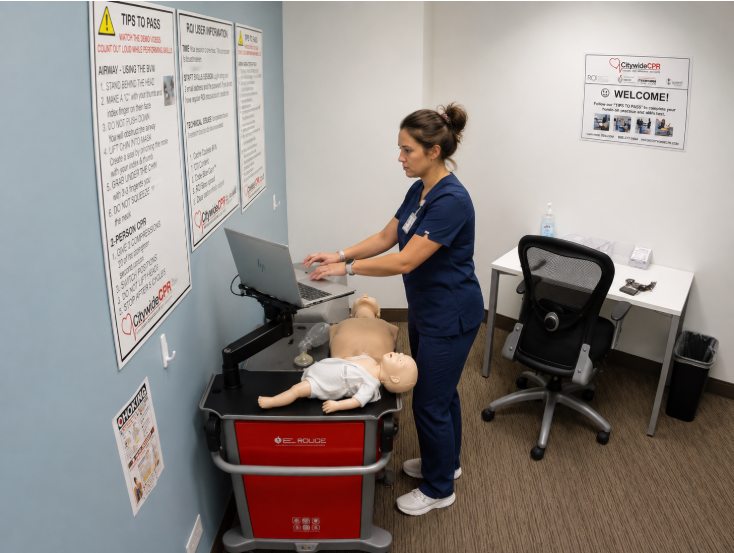
Attend your Citywide CPR Verification Station appointment and demonstrate the applicable BLS psychomotor skills using American Heart Association-compliant simulation technology.
Step 5: Receive Your AHA eCard
After successful completion of all required course components, Citywide CPR provides a Same-Day AHA eCard.
You can then submit the credential to your home health agency according to its requirements.
Can I Get BLS Certification Quickly for a New Home Health Job?
If you’re searching because an agency has offered you a position but says you cannot start until your BLS is current, begin with the exact certification requirement.
Then complete the necessary coursework and schedule your hands-on appointment as soon as possible.
Citywide CPR offers flexible Verification Station appointments at locations nationwide, making it easier to schedule certification around:
- Current work shifts
- New-hire orientation
- Patient visits
- School
- Family responsibilities
- An approaching start date
Use the Citywide CPR location finder to find a Citywide CPR location near you.
Can Home Health Care Workers Complete BLS Online?
Applicable blended-learning options can allow the educational portion of BLS to be completed online.
However, completing an online course should not automatically be confused with completing the entire certification process when hands-on skills verification is also required.
For an applicable blended-learning pathway, the process may look like:
Online coursework → Hands-on skills verification → Successful course completion → AHA eCard
This can be particularly convenient for home healthcare professionals whose schedules change throughout the day based on patient visits.
Can I Get My AHA BLS eCard the Same Day?
Citywide CPR provides Same-Day AHA eCards after successful completion of all required course components.
For a home healthcare professional, this can be especially useful when certification is holding up:
- A new position
- Patient assignments
- Employee onboarding
- Credentialing
- Certification renewal
Participants must successfully complete all applicable requirements before the eCard is issued.
What If My BLS Expired While I’m Working in Home Healthcare?
If you discover that your BLS Certification has expired, address it promptly.
Do not assume that there is an automatic grace period that allows you to continue working with an expired credential.
Your employer determines how an expired certification affects your position or patient assignments.
Check the expiration date, contact your employer if necessary, and begin the appropriate renewal process.
Agencies can reduce these last-minute situations by tracking staff expiration dates and beginning the renewal process before credentials lapse.
How Can a Home Health Agency Get Its Entire Staff CPR Certified?
For agency owners, administrators, HR teams, nursing directors, and training coordinators, managing CPR certification for an entire workforce presents a different challenge.
Rather than asking every employee to independently figure out what to do, the agency can establish which certifications apply to each role and create a consistent process for completing them.
Citywide CPR offers two practical approaches for healthcare organizations.
Option 1: Use Nearby Citywide CPR Verification Stations
If Citywide CPR locations are convenient to your workforce, employees can schedule individual appointments around patient assignments and work schedules.
This approach can work particularly well when employees have different expiration dates.
Instead of removing a large portion of the workforce from patient care simultaneously, the agency can stagger certification appointments.
Option 2: Bring Training to Your Organization
If you have a larger group or employees need to remain onsite, Citywide CPR can discuss Onsite CPR Training options.
For qualifying healthcare organizations, Citywide CPR’s portable RQI-P GO Simulation Station can bring healthcare-provider skills verification to the organization rather than requiring staff to travel to individual training locations.
This can be especially useful for healthcare employers trying to reduce staff travel and maintain operational coverage.
Healthcare organizations can also review CPR Training for Healthcare Staff – BLS, ACLS & PALS to compare available options.
Is Onsite BLS Training Better for a Home Health Agency?
It depends on the organization.
If only a handful of employees need renewal and a Citywide CPR Verification Station is nearby, individual appointments may be the simplest option.
If dozens of employees need certification within a similar timeframe, bringing training to the organization may reduce travel and simplify coordination.
Consider:
- Number of employees needing certification
- Certification expiration dates
- Distance to nearby training locations
- Staffing requirements
- Patient coverage
- Employee schedules
The best solution is the one that allows the organization to maintain appropriate certification while minimizing unnecessary disruption.
How Should Home Health Agencies Track CPR Certification Expiration Dates?
Waiting until an employee’s certification expires can create avoidable staffing problems.
Agencies should maintain a centralized record of applicable certification expiration dates and begin contacting employees well before renewal is due.
A simple process can include:
Track expiration → Notify employee → Select renewal option → Complete training → Collect new credential → Update employee record
For larger home health organizations, grouping employees by upcoming expiration periods can also make certification planning easier.
This turns CPR renewal into a predictable workforce process rather than an urgent problem every time a credential expires.
Frequently Asked Questions
Do home health care workers need CPR certification?
Many home healthcare employers require CPR training for employees who provide patient care, but requirements vary by position, employer, and other applicable rules. Verify the exact credential required for your job.
Do home health nurses need BLS Certification?
Many employers may require nurses to maintain BLS Certification. If your employer specifically requires American Heart Association BLS, register for the appropriate AHA BLS course.
Do home health aides need BLS?
Not necessarily. A home health aide’s requirements may differ from those of a nurse or other licensed healthcare professional. Ask your employer which exact CPR or BLS certification is required.
Is BLS the same as CPR for home health care workers?
BLS includes CPR, but BLS and general CPR courses are not automatically interchangeable. The appropriate course depends on the employee’s role and the employer’s requirements.
Can I get BLS online for a home health job?
Applicable blended-learning BLS options can include online education, but hands-on skills verification may also be required to complete certification.
How quickly can I get BLS certified for a new home health job?
Timing depends on the required course, completion of online education, appointment availability, and successful completion of all requirements. Citywide CPR offers flexible Verification Station appointments nationwide.
Can I receive my AHA BLS eCard the same day?
Citywide CPR provides Same-Day AHA eCards after successful completion of all required course components.
How can I get my entire home health staff CPR certified?
Home health agencies can send employees to nearby Citywide CPR Verification Stations or contact Citywide CPR to discuss coordinated healthcare staff and onsite training options.
Can BLS training come to our facility?
For qualifying healthcare organizations, Citywide CPR can discuss onsite training using the portable RQI-P GO Simulation Station, allowing healthcare-provider skills verification to be brought to the organization.
Need CPR or BLS Certification for Your Home Health Job?
If your employer requires American Heart Association BLS Certification, review Citywide CPR’s BLS options and choose the course that matches your requirement:
https://www.citywidecpr.com/bls-certification/
Then find a convenient Verification Station:
https://www.citywidecpr.com/locate-us/
Managing certification for an entire home health agency?
Citywide CPR can help healthcare organizations coordinate BLS, ACLS, and PALS training while reducing disruption to staffing and patient care:
https://www.citywidecpr.com/cpr-training-for-healthcare-staff/
For organizations interested in bringing training directly to their facility: