BLS and ACLS are both important American Heart Association training programs, but they cover different levels of resuscitation care. If your employer, hospital, school, clinical program, or credentialing department tells you that you need one—or both—it is important to understand the difference before registering.
The main difference between BLS and ACLS is the level and scope of care covered. BLS focuses on foundational lifesaving skills such as high-quality CPR, AED use, ventilation, and team-based basic life support. ACLS builds on foundational resuscitation knowledge and focuses on advanced cardiovascular emergencies, including cardiac arrest, arrhythmias, advanced airway considerations, medications, and advanced team-based resuscitation.
One does not automatically replace the other. Depending on your role and the requirements established by your employer or organization, you may need BLS, ACLS, or both.
What Is BLS Certification?
BLS, or Basic Life Support, teaches foundational resuscitation skills used during cardiac arrest, respiratory arrest, and other life-threatening emergencies.
American Heart Association BLS is designed for healthcare professionals and other personnel who need to know how to perform CPR and other basic cardiovascular life support skills in a wide variety of settings.
BLS training includes concepts and skills such as:
- High-quality CPR for adults, children, and infants
- Recognition of life-threatening emergencies
- Use of an automated external defibrillator (AED)
- Effective ventilations
- Relief of foreign-body airway obstruction
- Multiple-rescuer CPR
- Team dynamics during resuscitation
Healthcare professionals, healthcare students, first responders, and others in clinical environments may be required to maintain BLS certification. The exact requirement, however, is determined by the employer, school, facility, licensing body, or other organization involved.
If you are preparing for BLS, Citywide CPR’s BLS Study Guide provides additional review of important BLS concepts.
What Is ACLS Certification?
ACLS, or Advanced Cardiovascular Life Support, focuses on the advanced assessment and management of adult cardiovascular emergencies.
ACLS builds on foundational life support knowledge and is intended for healthcare professionals whose roles may involve managing cardiac arrest and other cardiovascular emergencies.
ACLS training addresses topics such as:
- Recognition and management of cardiac arrest
- Recognition and management of significant arrhythmias
- Advanced airway considerations
- ACLS medications
- Effective resuscitation team dynamics
- Post-cardiac arrest care
- Acute coronary syndromes
- Stroke-related assessment and systems of care
Because ACLS involves advanced clinical concepts, it should not be treated as simply a more difficult version of a CPR course. It serves a different training purpose.
Healthcare professionals preparing for ACLS can use Citywide CPR’s ACLS Study Guide to review major course concepts.
BLS vs. ACLS: What Are the Main Differences?
BLS provides foundational CPR and basic life support skills, while ACLS addresses advanced cardiovascular resuscitation and management.
| Topic | BLS | ACLS |
| Full name | Basic Life Support | Advanced Cardiovascular Life Support |
| Primary focus | Foundational CPR and basic cardiovascular life support | Advanced management of cardiovascular emergencies |
| CPR skills | Yes | Builds on foundational resuscitation skills |
| AED/defibrillation concepts | AED use | Advanced rhythm and defibrillation-related management |
| Airway | Basic ventilation and airway skills | Includes advanced airway considerations |
| Medications | Not a primary BLS focus | Includes applicable ACLS medications |
| Rhythm recognition | Not the primary focus | Important component of ACLS |
| Team dynamics | Included | Included at an advanced resuscitation level |
| Common audience | Healthcare professionals, students, first responders, and others requiring BLS | Healthcare professionals involved in applicable cardiovascular emergency care |
| Automatically replaces the other? | No | No |
BLS and ACLS overlap in the broader goal of improving resuscitation response, but they are separate credentials and should not automatically be treated as interchangeable.
Who Commonly Needs BLS Certification?
BLS is commonly required for people working or training in healthcare environments, but the exact requirement varies by role and organization.
People who may encounter a BLS requirement include:
- Nurses
- Nursing students
- Physicians
- Medical assistants
- Dental professionals
- EMS professionals
- Respiratory therapists
- Allied health professionals
- Other clinical staff
This does not mean every person with one of these job titles universally needs the same certification.
For example, a nursing program may specifically require an AHA BLS Provider credential before clinical rotations, while a particular workplace may have different requirements.
Always check the exact language provided by the organization requesting your certification.
Who Commonly Needs ACLS Certification?
ACLS is commonly required for healthcare professionals whose roles involve advanced management of adult cardiovascular emergencies.
Depending on the facility and clinical responsibilities, ACLS requirements may apply to professionals working in areas such as:
- Emergency care
- Critical care
- Intensive care
- Cardiac care
- Advanced emergency response
- Certain procedural or acute-care environments
A job title by itself is not enough to determine whether ACLS is required.
Two nurses, physicians, or other healthcare professionals can have different certification requirements because they work in different departments or perform different clinical responsibilities.
Your employer, facility, program, or credentialing body should determine whether ACLS is required for your specific role.
Do I Need BLS and ACLS?
Possibly. Some healthcare professionals are required to maintain both BLS and ACLS because the two certifications cover different levels of resuscitation care.
A common question is:
“If I have ACLS, do I still need BLS?”
The answer depends on your certification requirements.
ACLS builds on foundational resuscitation knowledge, but an ACLS credential does not automatically replace a separate BLS credential when your employer, facility, or program requires both.
For example, one healthcare professional may need:
BLS + ACLS
Another may require:
BLS only
Someone working in an applicable pediatric setting may need:
BLS + PALS
or:
BLS + ACLS + PALS
The correct combination depends on the person’s responsibilities and the requirements established by the organization.
Does ACLS Include BLS?
ACLS builds on foundational BLS knowledge, but you should not assume ACLS substitutes for a required BLS credential.
This distinction matters when submitting credentials to a hospital, healthcare employer, nursing program, or credentialing department.
If your organization says you must maintain BLS and ACLS, completing ACLS should not be treated as permission to let your separate BLS credential expire.
Follow the exact certification requirements you have been given.
BLS vs. ACLS for Healthcare Professionals: Which Should I Take?
Take the certification—or combination of certifications—specified for your healthcare role rather than choosing based on which course sounds more advanced.
If your requirement says:
AHA BLS Provider → complete the appropriate BLS pathway.
If it says:
AHA ACLS Provider → complete the appropriate ACLS pathway.
If it says:
BLS and ACLS → maintain both applicable credentials.
This is especially important for healthcare professionals or students moving between facilities. A credential accepted for one role should not automatically be assumed to satisfy the requirements of another employer or clinical program.
Is ACLS Harder Than BLS?
BLS and ACLS cover different levels of resuscitation care, so describing ACLS simply as “harder BLS” is not particularly useful.
BLS concentrates on foundational lifesaving skills.
ACLS involves additional advanced clinical concepts, including rhythm recognition, medications, advanced cardiovascular emergency management, and coordinated resuscitation care.
Someone preparing for ACLS may therefore need knowledge that falls outside the primary scope of BLS.
Rather than focusing on which course is “harder,” focus on which certification your role requires and what knowledge you need to successfully complete that course.
How Do BLS and ACLS Certification Work at Citywide CPR?
Citywide CPR is an American Heart Association Training Center offering applicable BLS and ACLS certification and renewal pathways, including Online + Skills and Skills Only options.
Which option you choose depends on what you have already completed.
What Is Online + Skills?
Online + Skills is for a participant who still needs the applicable AHA HeartCode online coursework and the required hands-on skills portion.
For an applicable blended-learning pathway, the participant completes the required HeartCode online learning and then attends the corresponding hands-on skills session.
What Is Skills Only?
Skills Only is for an eligible participant who has already completed the applicable AHA HeartCode online course and now needs the corresponding hands-on skills portion.
For example, someone who has already completed the appropriate HeartCode BLS coursework may register for the applicable BLS Skills Only option rather than purchasing the online coursework again.
Similarly, ACLS participants should select the pathway corresponding to the ACLS components they have already completed.
A previous BLS or ACLS Provider eCard alone should not be confused with completion of the current HeartCode online coursework needed for a Skills Only pathway.
Are BLS and ACLS Hands-On?
Yes. Applicable Citywide CPR BLS and ACLS pathways include required hands-on skills. Self-Guided Learning does not mean online-only training.
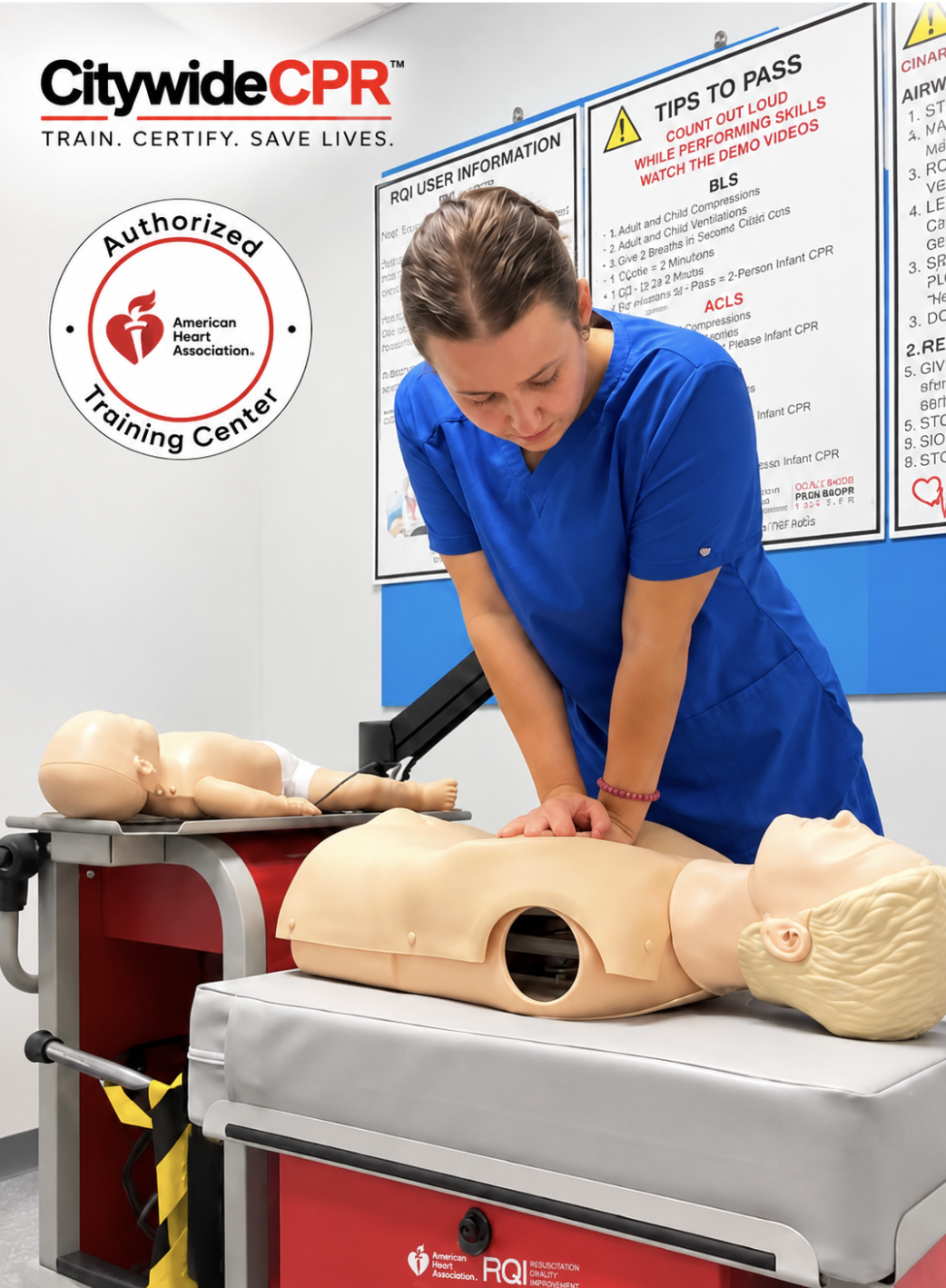
At Citywide CPR, applicable hands-on training can be completed through a Self-Guided Skills Session at a CPR Verification Station™ learning center.
Participants physically perform the applicable resuscitation skills using training equipment while the technology provides instructions and real-time performance feedback.
A typical applicable pathway looks like:
HeartCode online learning → Self-Guided Skills Session → successful completion of required course components → applicable AHA eCard
For a deeper explanation of this training format, see Self-Guided CPR Training.
Participants who want additional visual preparation can also review Citywide CPR’s BLS, ACLS and PALS Skills Demonstration Video Library when those demonstrations are relevant to the course they are completing.
What Happens When I Renew BLS or ACLS?
Renewal still requires completing the appropriate current course pathway. Being a renewal participant does not automatically mean you qualify for Skills Only.
First determine:
- Which certification you need to renew
- Whether you already completed the applicable HeartCode online coursework
- Whether Online + Skills or Skills Only is appropriate
- Where you will complete the required hands-on portion
If you already completed the applicable HeartCode course and have the required completion documentation, Skills Only may be appropriate.
If you still need the applicable online learning, choose the corresponding Online + Skills pathway.
After successful completion of all required course components, the applicable AHA eCard can be issued according to current processing procedures.
Should I Renew BLS and ACLS at the Same Time?
You may choose to coordinate BLS and ACLS training when you are required to maintain both credentials, but there is no universal rule that they must be renewed together.
Some healthcare professionals find it practical to coordinate certification timelines when multiple credentials are required.
Others may have different expiration dates or employer deadlines.
The important point is to keep each required credential current according to the requirements established for your role.
Do not take ACLS solely because you are renewing BLS, and do not assume that renewing ACLS automatically renews BLS.
What BLS or ACLS Certification Does My Healthcare Staff Need?
Healthcare organizations may have employees who need BLS, ACLS, PALS, or combinations of these credentials depending on their roles and applicable organizational requirements.
For example, the certification needs of employees working in an outpatient medical practice may differ from those of staff working in critical care, emergency services, pediatric care, or another clinical environment.
Practice managers, healthcare administrators, clinical educators, credentialing teams, and others coordinating certification should determine the required credential for each role rather than applying one certification combination to every employee.
That may mean organizing staff into groups such as:
- Employees who require BLS
- Employees who require BLS and ACLS
- Employees who require BLS and PALS
- Employees who require BLS, ACLS, and PALS
- Employees with other organization-specific requirements
Citywide CPR’s CPR Training for Healthcare Staff – BLS, ACLS & PALS explains options for healthcare organizations coordinating certification and renewal for multiple employees.
The same core principle applies to individuals and organizations: the employee’s role and applicable requirements determine which certification or combination is appropriate.
How Do I Choose Between BLS and ACLS?
Start with the requirement you were given—not with the course name that sounds more advanced.
If your requirement says BLS, choose the appropriate BLS certification pathway.
If your requirement says ACLS, choose the appropriate ACLS certification pathway.
If your requirement says BLS + ACLS, plan to maintain both credentials.
If you are unsure, ask the employer, school, facility, clinical program, or credentialing department requesting the certification.
If you need to locate a training provider, CPR Finder can also help you search for CPR certification options.
Frequently Asked Questions
What is the difference between BLS and ACLS?
BLS focuses on foundational CPR and basic life support skills, while ACLS addresses advanced cardiovascular emergency management. ACLS includes concepts such as cardiac arrest management, rhythm recognition, medications, advanced airway considerations, and advanced team-based resuscitation.
Is ACLS the same as BLS?
No. BLS and ACLS are separate certifications covering different levels of resuscitation care. Having ACLS should not automatically be treated as a replacement for BLS when an organization requires a separate BLS credential.
Do I need BLS before ACLS?
ACLS builds on foundational BLS knowledge and skills. Follow the current prerequisites and requirements associated with the ACLS course you are taking, as well as any requirements established by your employer or organization.
Do I need both BLS and ACLS?
You may. Some healthcare professionals are required to maintain both BLS and ACLS, while others need only BLS or another combination of credentials. Your role and applicable employer, facility, school, or credentialing requirements determine what you need.
Is ACLS only for doctors and nurses?
No. ACLS requirements are based on clinical responsibilities and organizational requirements rather than only a particular job title. Various healthcare professionals involved in applicable advanced cardiovascular emergency care may need ACLS.
Does ACLS replace BLS?
Do not assume it does. If an employer or program requires both BLS and ACLS credentials, maintain both according to its requirements.
Is BLS only for healthcare professionals?
AHA BLS is commonly used by healthcare professionals and other personnel who need foundational basic life support skills. Whether BLS is the correct certification for you depends on the requirement you have been given.
Are BLS and ACLS available through Self-Guided Learning?
Yes. Citywide CPR offers applicable BLS and ACLS pathways using Self-Guided Learning, with required hands-on skills completed during a Self-Guided Skills Session at a CPR Verification Station™ learning center.
Can I complete BLS or ACLS entirely online?
Applicable HeartCode learning can be completed online, but online coursework alone should not be confused with completion of a certification pathway that also requires hands-on skills.
What is the difference between Online + Skills and Skills Only?
Online + Skills is for someone who still needs the applicable HeartCode online course and required hands-on session. Skills Only is for an eligible participant who already completed the applicable HeartCode coursework and needs the corresponding hands-on portion.
Can I renew BLS and ACLS together?
Yes, you can coordinate BLS and ACLS training when you need both credentials. However, the certifications remain separate, and you should maintain each according to your employer’s or organization’s requirements.
When do I receive my AHA eCard?
The applicable AHA eCard is issued after successful completion of all required course components and according to current processing procedures.
Need BLS, ACLS, or Both?
If you are deciding between BLS and ACLS, begin with the exact credential required for your healthcare role, school, clinical program, or workplace.
Citywide CPR is an American Heart Association Training Center offering applicable BLS and ACLS certification and renewal pathways, including Online + Skills, Skills Only, and hands-on Self-Guided Skills Sessions at CPR Verification Station™ learning centers.
Use the BLS Study Guide or ACLS Study Guide to prepare for the certification you need, and explore Self-Guided CPR Training to learn how Citywide CPR’s hands-on training model works.
For organizations coordinating certification for multiple employees, visit CPR Training for Healthcare Staff – BLS, ACLS & PALS.