If you already hold an American Heart Association ACLS certification, you may wonder whether you still need a separate BLS certification. The short answer is: ACLS does not automatically replace a separately required BLS Provider credential. Whether you need both depends on your employer, school, healthcare facility, credentialing organization, and the requirements associated with your role.
The American Heart Association explains that BLS is not included in the ACLS course. Although ACLS participants are expected to be proficient in BLS skills, the AHA does not universally require students to hold a current BLS Provider card as an ACLS prerequisite. Individual Training Centers may establish additional requirements.
That distinction matters because having ACLS does not necessarily mean your BLS requirement has been satisfied. If your employer or clinical program specifically requires both credentials, you should maintain both.
Does ACLS Certification Replace BLS Certification?
No. BLS and ACLS are separate American Heart Association courses with different purposes.
BLS focuses on foundational life support skills, including high-quality CPR, AED use, ventilation, recognition of life-threatening emergencies, and coordinated basic resuscitation. ACLS addresses advanced cardiovascular emergencies and builds on foundational resuscitation knowledge with topics such as rhythm recognition, advanced airway considerations, medications, cardiac arrest management, and post-cardiac-arrest care. cpr.heart.org
Citywide CPR’s existing BLS vs. ACLS comparison provides a broader explanation of the clinical differences between the two courses. This article focuses on the practical question that often comes next: Do I need to keep both credentials current?
If your organization requires BLS and ACLS, your ACLS certification should not be treated as a substitute for your separate BLS certification.
Why Do Healthcare Professionals Sometimes Need Both BLS and ACLS?
Healthcare professionals may need both because the credentials serve different purposes. BLS establishes foundational resuscitation competency, while ACLS addresses the advanced management of adult cardiovascular emergencies.
A healthcare professional may therefore be expected to maintain BLS as a foundational credential while also holding ACLS because of the clinical responsibilities associated with the position.
The exact combination is not universal. A nurse in one department may have different requirements from a nurse working in an emergency department or intensive care setting. The same principle applies to physicians, paramedics, respiratory therapists, advanced practice providers, and other healthcare professionals.
The safest approach is to follow the exact certification requirements provided by your employer, school, facility, licensing organization, or credentialing department.
BLS Requirements for Nurses and Healthcare Professionals
BLS is commonly required for healthcare professionals who need foundational skills for responding to cardiac arrest and other life-threatening emergencies. The AHA BLS course covers high-quality CPR, AED use, ventilations, and other foundational life-support skills.
For example, a nurse may be required by an employer to maintain BLS even if that same nurse also needs ACLS. A medical student may need BLS for clinical training without needing ACLS. Another healthcare professional may need both.
Because requirements vary, do not assume your job title alone determines which credential you need. Check the written requirements from the organization requesting your certification.
If you need to complete or renew BLS, you can review Citywide CPR’s AHA BLS certification and renewal options before choosing a registration pathway.
ACLS Requirements for Emergency and Critical Care Teams
ACLS is designed for healthcare professionals who direct or participate in the management of cardiac arrest, stroke, and other cardiopulmonary emergencies. The AHA identifies professionals such as physicians, nurses, paramedics, and emergency or critical-care personnel among those who may need ACLS based on their responsibilities.
However, ACLS does not automatically mean that a separate BLS credential is unnecessary. If your employer specifically requires both AHA BLS and ACLS, you should keep both certifications current.
What’s the Difference Between BLS and ACLS Skills?
BLS and ACLS overlap in their emphasis on effective resuscitation, but the courses address different levels of emergency care.
BLS emphasizes foundational skills such as:
- High-quality CPR
- AED use
- Ventilations
- Basic airway and resuscitation skills
- Adult, child, and infant life-support techniques
- Team-based basic life support
ACLS builds on foundational resuscitation knowledge and addresses advanced adult cardiovascular emergency care, including rhythm recognition, cardiac arrest management, medications, advanced airway considerations, and coordinated resuscitation. cpr.heart.org
This is why having an ACLS credential does not automatically satisfy a separate BLS requirement. The courses are related, but they are not interchangeable credentials.
Can You Take ACLS Without a Current BLS Certification?
According to the American Heart Association, students taking ACLS are not universally required by the AHA to hold a current BLS Provider card, although they are expected to be proficient in BLS skills. A Training Center may establish a requirement for a current BLS card.
The AHA’s current ACLS guidance also expects ACLS participants to be proficient in high-quality BLS skills, along with other foundational competencies such as ECG interpretation, ACLS pharmacology, and bag-mask ventilation.
That creates an important distinction:
AHA course prerequisite: The AHA does not universally require a current BLS Provider card before ACLS.
Employer or organization requirement: Your employer, school, facility, or credentialing body may separately require you to maintain a current BLS Provider credential.
Before registering for ACLS, confirm both the course requirements and the requirements of the organization that will accept your certification.
Do BLS and ACLS Certifications Expire at the Same Time?
Not necessarily.
AHA BLS and ACLS course completion credentials are generally valid for two years, but each credential has its own completion date and expiration date. cpr.heart.org
For example, you could complete BLS in January and ACLS in July. Even though both credentials have a typical two-year validity period, their expiration dates would not automatically be the same.
This is one reason healthcare professionals who need both certifications should keep track of each eCard separately.
Do not assume that renewing ACLS also renews BLS, or that renewing BLS automatically renews ACLS.
How to Renew Your BLS and ACLS Certifications Together
If your employer requires both credentials, coordinating your training can be a practical way to manage multiple certification requirements. However, BLS and ACLS remain separate courses, and you should select the appropriate pathway for each one.
Citywide CPR offers applicable BLS and ACLS certification and renewal options through its Self-Guided Learning model at participating locations.
Complete Your AHA HeartCode Online Courses
For an applicable Online + Skills pathway, you complete the appropriate AHA HeartCode online course before attending your hands-on skills session.
If you need both BLS and ACLS, you would complete the corresponding online coursework for each certification you are required to obtain.
If you have already completed the applicable HeartCode online course for one of the certifications, you may be eligible to register for that course’s Skills Only option rather than purchasing the online portion again.
For example, if your HeartCode BLS course is already complete, you can review BLS Skills Only. If you still need the complete BLS pathway, BLS Online + Skills includes the applicable online learning and hands-on component.
For ACLS, review the ACLS certification and renewal options and select the pathway that matches the coursework you have already completed.
Complete Your Hands-On Skills Sessions
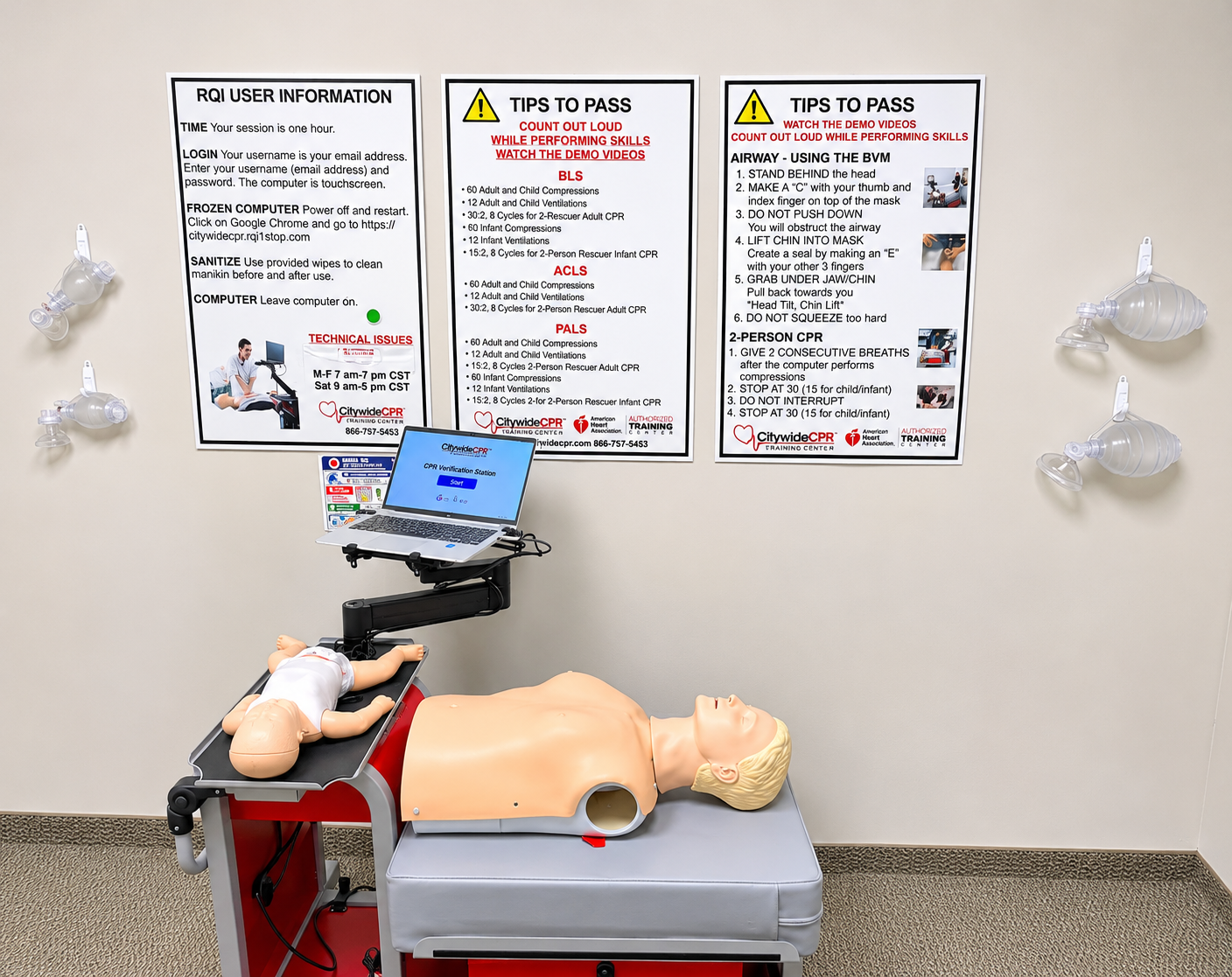
Applicable BLS and ACLS blended-learning pathways include a required hands-on component. Citywide CPR provides Self-Guided Skills Sessions at participating CPR Verification Station™ learning centers.
During the session, participants physically perform the required skills using training equipment while Voice-Assisted Manikin technology provides instructions and real-time performance feedback.
Self-Guided does not mean online-only. The online coursework and hands-on skills session serve different parts of the applicable training pathway.
Citywide CPR’s Self-Guided CPR Training page explains how the technology-guided skills experience works for applicable BLS, ACLS, and PALS pathways.
Skills sessions typically take approximately 15–30 minutes per course, although actual completion time can vary. That timeframe refers to the hands-on appointment—not the complete online and skills certification process.
Receive Your Official AHA eCards
After you successfully complete the required course components and skills session, your applicable American Heart Association certification documentation is processed.
The official American Heart Association eCard is processed the same day after successful completion of course requirements and the skills session.
If you are maintaining both BLS and ACLS, each certification remains a separate credential. Make sure you provide the appropriate eCard to the employer, school, facility, or credentialing organization requesting it.
How Citywide CPR Makes BLS and ACLS Certification Convenient
Citywide CPR is an American Heart Association Training Center offering BLS, ACLS, and PALS certification and renewal through participating training locations.
For eligible Self-Guided pathways, the process separates the online learning from the hands-on skills experience. You can complete the applicable HeartCode coursework at your own pace and then attend a scheduled skills session using CPR Verification Station technology.
This can be useful for healthcare professionals who need to coordinate multiple certifications around work, clinical responsibilities, school, or other commitments.
When registering for more than one certification, pay attention to the individual course requirements. You may need Online + Skills for one course and Skills Only for another, depending on which HeartCode coursework you have already completed.
Citywide CPR’s ACLS certification and renewal information provides additional guidance for professionals planning ACLS training.
Find AHA BLS and ACLS Certification or Renewal Near You
If you have been told to maintain both BLS and ACLS, start by confirming the exact requirements from your employer, school, facility, or credentialing organization. Then check the expiration date of each current credential and determine whether you need Online + Skills or Skills Only for each course.
Citywide CPR offers participating locations nationwide. You can use the Citywide CPR location finder to find a location and review available BLS and ACLS training options.
If you need BLS only, choose the appropriate BLS pathway. If you need ACLS only, select the applicable ACLS pathway. If your organization requires both, register for both certifications and keep each credential current according to its own expiration date and your organization’s requirements.
The key takeaway is simple: ACLS does not automatically replace BLS. If your employer or other organization requires both, maintaining both certifications is the safest way to keep your credentials aligned with your professional requirements.