Organizations with employees spread across different offices, cities or facilities face a practical challenge when certification comes due: How do you get everyone trained without requiring the entire team to travel to one location on the same day?
A healthcare organization may have employees working at several clinics. A dental group may have multiple practices across a region. A company may have employees at branch offices in different cities. In each situation, coordinating CPR or BLS certification can become a scheduling problem as much as a training problem.
The good news is that employee certification does not necessarily have to follow the same schedule or delivery format for everyone. Depending on the organization’s needs, Citywide CPR can help coordinate a combination of onsite training, portable skills options, individual appointments and applicable online learning.
What If Your Employees Don’t All Work in the Same Location?
When employees are spread across multiple locations, bringing everyone together for one training session may not be practical.
For example, an organization might have:
- Several healthcare clinics in different cities
- A dental group with multiple offices
- Regional business locations
- Employees working from different facilities
- A central office with additional employees working elsewhere
- Teams with different shifts or operating schedules
The first step is to look at the organization as a whole rather than assuming every employee needs to follow exactly the same training schedule.
Consider where employees work, which certifications they need, when their certifications expire and how much time they can reasonably spend away from their normal responsibilities.
A Multi-Location Training Plan Does Not Have to Be Identical for Everyone
One group might be able to complete training together at its primary workplace while employees at another location schedule individual skills sessions.
Similarly, employees who need the applicable online component may be able to complete that portion before attending their hands-on skills session, reducing the amount of time they need to spend at the training location.
The appropriate approach depends on the organization’s employee count, locations, certification requirements and scheduling needs.
How Can an Organization Train Employees Across Multiple Locations?
Citywide CPR is an American Heart Association Training Center and offers several approaches that organizations can consider when coordinating certification for employees in different locations.
Depending on the situation, an organization may consider:
- Onsite group training at an organization’s workplace or facility
- Portable training and skills verification options for applicable onsite programs
- Citywide CPR locations and CPR Verification Stations for employees who need to schedule individually
- Online + Skills options when applicable
- Staggered appointments based on employee schedules
- Different training arrangements for different offices or employee groups
These options do not necessarily need to be used separately. An organization can discuss its employee locations, certification needs and scheduling constraints with Citywide CPR to determine an appropriate approach.
See How Multi-Location Employee Training Can Work
If your employees are spread across different cities or offices, the challenge is often figuring out how to coordinate everyone without forcing the entire organization into one schedule.
Here’s a quick look at the type of multi-location training problem Citywide CPR can help organizations address:
After watching the video, the important takeaway is that employee training can be coordinated around the organization’s actual structure. Employees do not necessarily need to work in the same location or attend the exact same session for an organization to manage its certification needs.
Onsite CPR Training for Multiple Offices
For organizations that want to bring training directly to their employees, onsite training can be one option to consider.
Rather than requiring employees to travel individually to an outside training location, an organization can discuss whether bringing applicable training to the workplace makes sense for its group.
This can be particularly useful for organizations with a larger team at one facility or for groups that want to coordinate training around their normal operating schedule.
Citywide CPR’s onsite CPR and BLS training for staff and groups page provides more information about the organization’s workplace and group training options.
For a multi-location organization, however, onsite training does not necessarily mean that every location must be handled in exactly the same way. One office may be able to coordinate a group session while another may need a different arrangement.
Can Employees at Different Locations Use Citywide CPR Locations?
Yes, employees may be able to schedule individual skills sessions at available Citywide CPR locations, depending on the applicable course and location.
This can be useful when employees work in different cities or have schedules that make a single group session difficult.
For example, a company could have employees in several markets who complete their applicable online learning and then schedule their hands-on skills appointments individually at available Citywide CPR locations.
This approach can help an organization stagger training rather than taking every employee away from work at the same time.
The specific course and scheduling options available can vary by location, so organizations should confirm the appropriate pathway when planning their training.
How Online + Skills Options Can Help With Scheduling
For applicable AHA certification pathways, Online + Skills can provide another way to manage employee schedules.
Employees complete the appropriate online learning before their scheduled hands-on skills session. This separates the learning component from the in-person skills component and can provide additional flexibility when coordinating multiple employees.
For organizations with employees in several locations, this can make scheduling easier because employees may not all need to complete every portion of the training at the same time.
Where applicable, employees can then attend their scheduled Self-Guided Skills Session and practice and perform skills using the training equipment and real-time feedback.
The specific requirements and available formats depend on the certification and organization, so employers should confirm the appropriate course pathway before scheduling.
What About Portable Training for Employees at Different Locations?
Another option for applicable programs is portable skills training and verification.
The basic idea is simple: instead of requiring employees to travel to a training center, appropriate portable equipment can be brought to an organization’s facility.
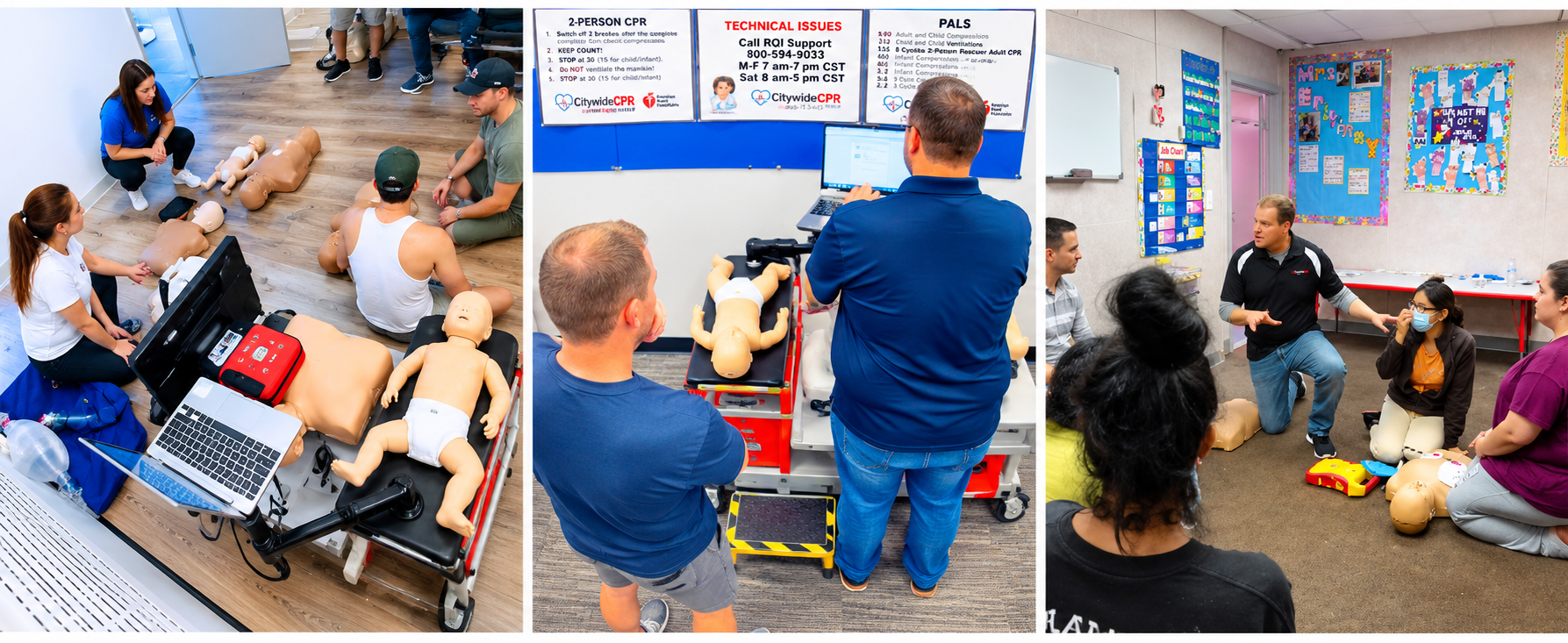
Citywide CPR can use portable CPR skills training and verification equipment for applicable onsite programs. This can be particularly useful when an organization wants to coordinate employee skills training at a workplace or facility.
The potential advantages for an organization include:
- Reducing employee travel
- Simplifying scheduling
- Keeping training closer to the workplace
- Coordinating skills sessions around operational needs
- Helping minimize time away from normal shifts
Portable training is not automatically the right solution for every course, organization or location. It is one option to discuss when an organization has employees who are difficult to coordinate through a single offsite training session.
How Does Multi-Location Training Work for Healthcare Organizations?
Healthcare organizations often have an additional consideration: different employees may have different certification needs.
One organization might have nurses who need BLS, while other members of the team may have employer-specific requirements for ACLS or PALS.
Citywide CPR offers AHA BLS, ACLS and PALS certification and renewal options for applicable healthcare professionals.
The important point is that employers should not assume everyone needs the same certification.
Instead, identify:
- Which employees need BLS
- Which employees need ACLS, if applicable
- Which employees need PALS, if applicable
- Which employees are renewing versus completing initial certification
- When each employee’s current certification expires
- Where each employee works
- Whether employees can attend group training or need individual appointments
That information gives the organization a much clearer picture of how to coordinate training across locations.
For healthcare organizations that need broader staff-training assistance, Citywide CPR also provides healthcare staff training options.
What About Dental Groups With Multiple Offices?
A dental organization with several offices can face the same logistical challenge.
One practice may have dentists, hygienists, assistants and support staff working at one location, while another office operates in a different city.
Rather than assuming every employee must attend one large session, the organization can first determine which certification each employee needs and then consider the most practical scheduling arrangement for each office or group.
Depending on the organization’s needs, that might involve:
- Coordinating group training at one office
- Arranging applicable onsite training
- Using portable skills verification options
- Having employees schedule individual sessions
- Staggering appointments between different locations
Certification requirements can vary by state, licensing board, employer, role and practice setting. Organizations should confirm the specific requirements applicable to their employees before deciding which certification and training pathway to use.
How Can Multi-Location Training Reduce Disruption to the Workday?
The goal is not necessarily to eliminate all disruption. The goal is to avoid creating more disruption than necessary.
A company with 30 employees in five locations may not need to close or rearrange all five locations around one training session.
Instead, the organization can look at its staffing structure and determine whether training can be staggered.
For example:
Location A: Employees complete training during a coordinated onsite session.
Location B: Employees schedule individual skills appointments.
Location C: Employees complete applicable online learning before their scheduled skills sessions.
Location D: The organization discusses a portable onsite option.
The right arrangement depends on the organization’s circumstances. But considering multiple delivery options can give managers more flexibility than trying to force every employee into a single training schedule.
What Certifications Can Organizations Coordinate?
Citywide CPR supports several certification and training options depending on the needs of the organization.
BLS Training for Employees
BLS may be appropriate for employees whose employer, role, school or organization requires an AHA BLS certification.
For organizations with employees in multiple locations, BLS training can potentially be coordinated through group, onsite, individual or applicable Online + Skills pathways.
ACLS and PALS for Healthcare Staff
Healthcare organizations may also need to coordinate ACLS or PALS certification or renewal for applicable employees.
Not every healthcare employee needs these certifications. Requirements can vary based on the employee’s role and the organization’s requirements.
The important logistical question is how to coordinate the employees who do need them without unnecessarily taking everyone off the schedule.
CPR, AED and First Aid for Workplaces
Non-healthcare organizations may instead need CPR/AED, First Aid or related workplace training.
The appropriate course depends on the organization’s needs and employee responsibilities. A company does not necessarily need to train every employee in the same certification.
How Should an Organization Start Planning Multi-Location Training?
Before contacting a training provider, it can help to gather a few basic details.
1. Create an Employee List
Identify which employees need certification and where each person works.
2. Identify the Required Certification
Determine whether each employee needs CPR/AED, First Aid, BLS, ACLS, PALS or another applicable certification.
Confirm those requirements with the employer, facility, school, clinical program or other organization responsible for setting them.
3. Check Expiration Dates
Look at when each employee’s current certification expires.
If expiration dates are spread throughout the year, the organization may be able to stagger renewals rather than trying to renew everyone simultaneously.
4. Review Employee Schedules
Identify shifts, operating hours and locations where employees can reasonably complete training.
5. Discuss the Options
Provide the training provider with the employee count, locations, certifications needed and scheduling constraints.
This gives the provider the information needed to discuss whether onsite, portable, individual or blended options may be appropriate.
How Can Citywide CPR Help Coordinate Training Across Locations?
Citywide CPR’s role is not to assume that every organization should use the same training format.
Instead, an organization can explain its situation: how many employees need certification, where they work, which certifications they need and what scheduling limitations exist.
From there, Citywide CPR can help the organization explore applicable staff and group training options.
For organizations interested in coordinating training for employees across multiple locations, the next step is to explore employee and group training options.
Frequently Asked Questions About Multi-Location CPR Training
Can Citywide CPR train employees who work in different cities?
Organizations with employees in different cities can discuss available training arrangements with Citywide CPR. Depending on the course, location and organization, employees may be able to use a combination of onsite training, portable options, individual appointments at Citywide CPR locations and applicable online learning.
Does everyone have to attend CPR training at the same time?
No, not necessarily. Training does not always have to be organized as one session for every employee. Depending on the applicable course and organization, employees may be able to attend staggered sessions, schedule individual skills appointments or participate in group or onsite training.
Can employees complete part of their certification online?
For applicable AHA blended-learning pathways, employees can complete the appropriate online learning before completing the required hands-on skills component.
The exact requirements depend on the certification and training pathway, so employees should confirm which option applies before registering.
Can some employees train onsite while others use Citywide CPR locations?
Potentially. An organization with employees in multiple locations can discuss whether different training arrangements make sense for different groups. Availability depends on the course, location and applicable program requirements.
Can an organization coordinate BLS, ACLS and PALS for different staff roles?
Yes, an organization can discuss its different certification needs with Citywide CPR. However, not every employee needs the same certification, and requirements should be confirmed based on each employee’s role and the organization’s specific requirements.
How does onsite CPR training work for multiple offices?
An organization can discuss its locations, employee count, certification needs and scheduling requirements with Citywide CPR. Depending on the circumstances, training may be coordinated separately for different offices or through a combination of onsite, portable and individual options.
How do we request training for a group of employees?
Start by providing the organization name, approximate number of employees, locations, certifications needed and any scheduling considerations. Citywide CPR can then discuss the applicable staff and group training options.