Keeping an entire healthcare team current on BLS, ACLS and PALS certifications requires more than scheduling an occasional CPR class. The most effective approach is to treat certification as an ongoing workforce-management process: know which credential each employee needs, track individual expiration dates, start renewal before cards expire and give employees flexible ways to complete required training without pulling the whole team away from work at once.
For healthcare organizations, the challenge is rarely one employee.
It may be dozens—or hundreds—of nurses, medical assistants, physicians, dental professionals, clinical staff and other employees whose certifications expire at different times throughout the year.
A practical system should therefore allow employees to renew according to their own credential dates, rather than waiting until everyone needs training at the same time.
Citywide CPR’s CPR Training for Healthcare Staff – BLS, ACLS & PALS program is designed to help healthcare organizations coordinate these recurring certification needs while minimizing disruption to staffing and operations.
Why Is Managing Staff CPR Certification an Ongoing Problem?
Healthcare employers often begin with a straightforward requirement:
Certain employees must maintain a current BLS, ACLS, PALS or combination of credentials for their role.
The complication comes later.
Employees may:
- Start at different times
- Have different certification expiration dates
- Need different AHA courses
- Work different shifts
- Move between departments
- Take leave
- Change clinical responsibilities
- Need certification before a credentialing deadline
As a result, an organization that handles CPR training only when a large group happens to be expiring can quickly fall into a reactive cycle.
Someone notices a card is about to expire. A manager tries to find a class. Coverage has to be arranged. Several other employees discover that their cards expire next month.
A better approach is to manage certification continuously.
How Often Do BLS, ACLS and PALS Certifications Need to Be Renewed?
American Heart Association BLS, ACLS and PALS Provider credentials are generally issued for two years.
For an employer, however, the important operational date is not simply the two-year interval.
It is the individual expiration date for each employee.
If 25 employees were hired at different times, there is little reason to expect all 25 certifications to come due together.
That means employers should maintain a simple certification record containing at least:
- Employee name
- Required certification or certifications
- Current credential expiration date
- Department or role
- Renewal status
- Date renewal was completed
- Updated eCard information
This turns certification from an emergency into a predictable recurring process.
How Far in Advance Should Employers Start Tracking Renewals?
Do not wait until the expiration month to begin checking.
A practical process is to review upcoming expirations regularly and identify employees whose credentials will come due in advance.
That gives managers time to account for:
- Employee schedules
- Vacation or leave
- Online coursework
- Hands-on appointment availability
- Staffing coverage
- Credentialing deadlines
The exact lead time can vary by organization, but the objective should be consistent:
Renew before the credential becomes an urgent problem.
For larger organizations, a recurring monthly review of upcoming expiration dates can be much easier to manage than handling renewals one employee at a time as managers discover them.
Do All Healthcare Employees Need the Same Certification?
No.
One of the most important parts of managing a healthcare workforce is knowing which employees actually need which credential.
Many healthcare roles may require American Heart Association BLS, while ACLS or PALS may be required for particular departments, responsibilities or patient populations.
For example, an organization may have:
- Employees who need BLS only
- Employees who need BLS + ACLS
- Employees who need BLS + PALS
- Employees who need BLS + ACLS + PALS
Requirements are determined by the employer, clinical role and applicable credentialing standards.
ACLS or PALS should not automatically be treated as a replacement for BLS.
For managers, maintaining the certification requirement alongside each employee’s expiration date prevents staff from being assigned the wrong course.
Should Employers Renew Everyone at the Same Time?
Not necessarily.
A single annual training day may sound administratively simple, but it can create other problems.
Taking a large number of employees away from patient care simultaneously can require significant coverage and may be difficult for clinics, medical offices, dental organizations, hospitals and other healthcare environments.
It can also mean renewing some employees much earlier than necessary simply to make everyone fit the same schedule.
A more flexible model is to let employees complete training as their individual certification dates approach.
Instead of moving the entire team through one training event, employers can maintain an ongoing renewal schedule throughout the year.
Can Employees Complete Certification at Different Times?
Yes.
This is one of the most useful ways healthcare employers can reduce operational disruption.
Rather than scheduling an entire department for the same day, employees can complete applicable certification requirements individually or in smaller groups as their expiration dates approach.
For organizations near a Citywide CPR location, employees can schedule their hands-on Self-Guided Skills Sessions at nearby CPR Verification Stations around their work schedules.
That creates a rolling model:
Employee approaches expiration → completes required training → completes hands-on skills → submits updated eCard → employer updates certification record
Then the next employee follows the same process when their credential approaches expiration.
For many employers, this is easier to sustain than organizing repeated large-group training events.
Can Healthcare Employees Complete Online Learning Before Their Hands-On Skills?
For applicable American Heart Association blended-learning pathways, yes.
Employees can complete required online coursework independently before attending the corresponding hands-on skills portion.
This can be particularly useful for organizations because employees do not necessarily need to be away from the workplace for the entire educational portion at the same time.
Instead, applicable training can be divided into:
Online learning → Hands-on skills verification → Updated credential
The employee completes the appropriate learning requirements and then attends the required hands-on session.
This structure can make certification easier to coordinate around shifts and individual schedules.
What Is a Self-Guided Skills Session?
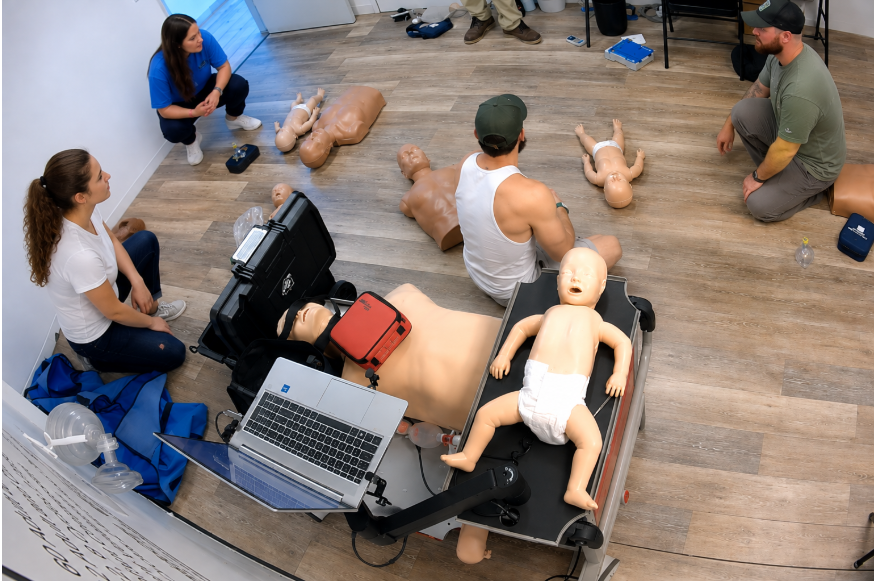
A Self-Guided Skills Session is a hands-on training experience in which technology guides the participant through applicable skills rather than requiring an instructor to continuously lead a traditional group classroom.
At Citywide CPR, applicable Self-Guided Skills Sessions take place at CPR Verification Stations.
Employees physically perform the required skills on training manikins while the system provides instructions and performance feedback.
Self-Guided does not mean online-only.
The hands-on component remains hands-on.
For employers, the advantage is that employees may be able to complete skills individually instead of requiring the entire team to attend one instructor-led session together.
Learn more about the format through Citywide CPR’s Self-Guided CPR Training resource.
How Can CPR Verification Stations Help Healthcare Employers?
For employers, the value of a CPR Verification Station is largely operational.
Employees can complete applicable hands-on requirements in scheduled individual sessions rather than moving an entire department through a group class.
This can help an organization:
- Spread renewals across the year
- Schedule around individual expiration dates
- Reduce the number of employees away from work simultaneously
- Accommodate different shifts
- Allow employees to complete required hands-on skills individually
- Maintain a more predictable certification process
A Verification Station does not replace the employer’s responsibility to determine which credentials each role requires.
It simply provides a more flexible way for applicable training to be completed.
What Is the Best Way to Manage Employees With Multiple Certifications?
Employees who need more than one credential require extra attention because their expiration dates may not always align.
For example, a clinician might require both BLS and ACLS but have the two credentials expiring months apart.
Employers have two basic choices:
They can allow each certification to continue on its existing schedule, or they can determine whether coordinating eligible certifications at a convenient point makes operational sense.
The right approach depends on staffing, course requirements and the organization’s credentialing process.
The important thing is not necessarily making every expiration date identical.
It is knowing what expires when and having a reliable process for acting before it becomes overdue.
How Should Employers Handle New Hires?
New hires are another reason certification tracking should be continuous.
When an employee joins the organization, managers should confirm:
- Which certifications are required for the role
- Whether the employee already holds the required credentials
- The expiration date of each credential
- Whether any certification must be completed before beginning clinical duties
- When that employee should enter the organization’s renewal cycle
Do not assume that because a new employee says they are “CPR certified,” they necessarily hold the exact BLS, ACLS or PALS credential your organization requires.
Confirm the actual credential and expiration date.
Then add it to the same tracking system used for the rest of the staff.
What Should Employers Do After an Employee Completes Training?
Certification management should not end when the employee says, “I finished.”
The organization should update its records with the new credential information and expiration date.
Citywide CPR provides Same-Day AHA eCards after successful completion of all required course components, which can help employers update credentialing records promptly.
A repeatable workflow might be:
Employee completes training → eCard is received → employee or manager provides documentation → employer updates expiration record → next renewal date is tracked
That final administrative step is what keeps the system working over the long term.
What If Taking Employees Offsite Is Difficult?
Some healthcare organizations cannot easily send employees away from the workplace.
This may be especially challenging when:
- Patient coverage is difficult
- Staffing levels are tight
- The facility operates continuously
- Employees cannot leave campus
- A large number of staff need training
In those situations, organizations can contact Citywide CPR about available portable skills verification and onsite training options.
Citywide CPR offers portable solutions that may allow applicable healthcare training to be coordinated at the organization’s facility when appropriate.
Availability and suitability depend on the organization and training need, so employers should contact Citywide CPR rather than assume an onsite option automatically applies.
The goal is the same either way: create a workable certification process without unnecessarily disrupting patient care and operations.
Nearby Verification Station or Onsite Training: Which Is Better for Ongoing Renewals?
For many healthcare organizations, these options solve different operational problems.
Nearby Citywide CPR Verification Station
This model works well when individual employees can leave the workplace for a scheduled appointment.
Employees can complete applicable online learning and then schedule their hands-on skills as their own certifications approach expiration.
This supports a rolling renewal model rather than moving the entire workforce through training at once.
Training at the Healthcare Facility
An onsite or portable solution may be worth discussing when employees cannot easily leave the workplace or when the organization’s staffing structure makes offsite appointments impractical.
The decision should be based on workforce size, operations, scheduling constraints and the organization’s particular training needs.
It does not have to be the same solution for every employer.
Can Citywide CPR Help Coordinate BLS, ACLS and PALS Training for Healthcare Staff?
Yes.
Healthcare organizations do not have to approach staff certification as a collection of unrelated individual registrations.
Citywide CPR’s CPR Training for Healthcare Staff – BLS, ACLS & PALS resource is specifically designed for organizations looking for a practical way to coordinate certification and renewal across a healthcare workforce.
Depending on the organization’s needs, employees may use nearby Citywide CPR Verification Stations for flexible individual appointments, while organizations with more complex operational constraints can discuss available onsite options.
The most useful starting point for an employer is to identify:
- How many employees need training
- Which certifications they require
- Current expiration dates
- Whether employees can travel to nearby locations
- Whether training needs to remain onsite
- Whether certifications are coming due together or throughout the year
From there, a recurring renewal process can be built around the actual workforce instead of forcing every employee into the same schedule.
What Does a Good Staff Certification Process Look Like?
The strongest system is usually simple.
Know the requirement → Track the expiration date → Begin renewal early → Let the employee complete the appropriate training → Collect the updated eCard → Record the next expiration date
Then repeat.
For a large healthcare team, this approach can turn BLS, ACLS and PALS certification from a recurring scheduling emergency into a manageable administrative process.
The goal is not merely to get everyone certified once.
It is to keep the workforce continuously current as employees, roles and expiration dates change.
Frequently Asked Questions
How can healthcare employers keep track of staff CPR certifications?
Maintain a centralized record showing each employee’s required BLS, ACLS or PALS credential, current expiration date, department or role, renewal status and updated credential information after completion.
How often do BLS, ACLS and PALS certifications need to be renewed?
American Heart Association BLS, ACLS and PALS Provider credentials are generally issued for two years. Employers should track the exact expiration date of each employee’s individual credential rather than relying only on a general two-year schedule.
Should employers wait until an employee’s certification expires before scheduling renewal?
No. Tracking upcoming expiration dates in advance gives employees time to complete applicable coursework and hands-on requirements before a credential lapse creates a staffing or credentialing problem.
Does every healthcare employee need BLS, ACLS and PALS?
No. Required certifications depend on the employee’s role, department, patient population and employer requirements. Some employees may require BLS only, while others may also need ACLS, PALS or both.
Can employees renew at different times?
Yes. Employees can complete applicable training as their individual certifications approach expiration rather than requiring the entire workforce to renew simultaneously.
Can healthcare employees complete online learning before their hands-on session?
For applicable blended-learning pathways, employees can complete required online education separately before attending the corresponding hands-on skills session.
What is a Self-Guided Skills Session?
A Self-Guided Skills Session is a hands-on session in which technology provides instructions and performance feedback as the participant completes applicable skills on training manikins.
How can CPR Verification Stations help an employer?
Verification Stations can allow employees to schedule applicable hands-on training individually around shifts and certification expiration dates, reducing the need to remove an entire team from work simultaneously.
Can employees complete BLS, ACLS and PALS at Citywide CPR Verification Stations?
Citywide CPR offers applicable Self-Guided Learning pathways for BLS, ACLS and PALS. Employees should complete the course appropriate for their role and employer requirements.
What if employees cannot leave the healthcare facility for training?
Organizations can contact Citywide CPR about available portable skills verification and onsite training options. Suitability and availability depend on the organization’s specific circumstances and training needs.
Should employers synchronize everyone’s certification expiration dates?
Not necessarily. For many organizations, a rolling system based on individual expiration dates is easier to manage and causes less staffing disruption than requiring all employees to renew simultaneously.
How should employers manage employees who need both BLS and ACLS or PALS?
Track each required credential separately, including its individual expiration date. Certifications can then be planned according to actual employee requirements rather than assuming all credentials expire together.
What should an employer do after an employee renews?
Collect or verify the updated credential, update the employee’s certification record and begin tracking the new expiration date for the next renewal cycle.
Can Citywide CPR help manage certification for an entire healthcare staff?
Yes. Citywide CPR works with healthcare organizations needing BLS, ACLS and PALS certification and renewal options for employees. Organizations can explore nearby Verification Station scheduling and discuss available onsite solutions depending on their needs.
Need a Better Way to Keep Your Healthcare Staff Certified?
If you’re responsible for tracking BLS, ACLS or PALS across multiple employees, the goal should be a repeatable system that keeps certifications current without repeatedly disrupting staffing and patient care.
Citywide CPR can help healthcare organizations coordinate certification and renewal based on employee requirements, expiration dates and operational needs.
CPR Training for Healthcare Staff – BLS, ACLS & PALS / Train My Staff
https://www.citywidecpr.com/cpr-training-for-healthcare-staff/
Employees who can travel to a nearby location can schedule applicable Self-Guided Skills Sessions individually, while organizations that have difficulty taking staff away from the workplace can discuss available onsite options with Citywide CPR.