What Is Citywide CPR’s RQI-P GO Portable Training System?
For healthcare organizations looking for a more flexible way to coordinate eligible American Heart Association certification, Citywide CPR offers RQI-P GO, a portable CPR skills training and verification solution designed to bring the hands-on component closer to the organization and its employees.
The system is intended for qualifying healthcare training arrangements where employees may benefit from completing their required skills verification at their own facility rather than traveling individually to a fixed training location. Citywide CPR’s healthcare staff program describes RQI-P GO as an onsite option for organizations coordinating BLS, ACLS and PALS certification and renewal for eligible healthcare professionals.
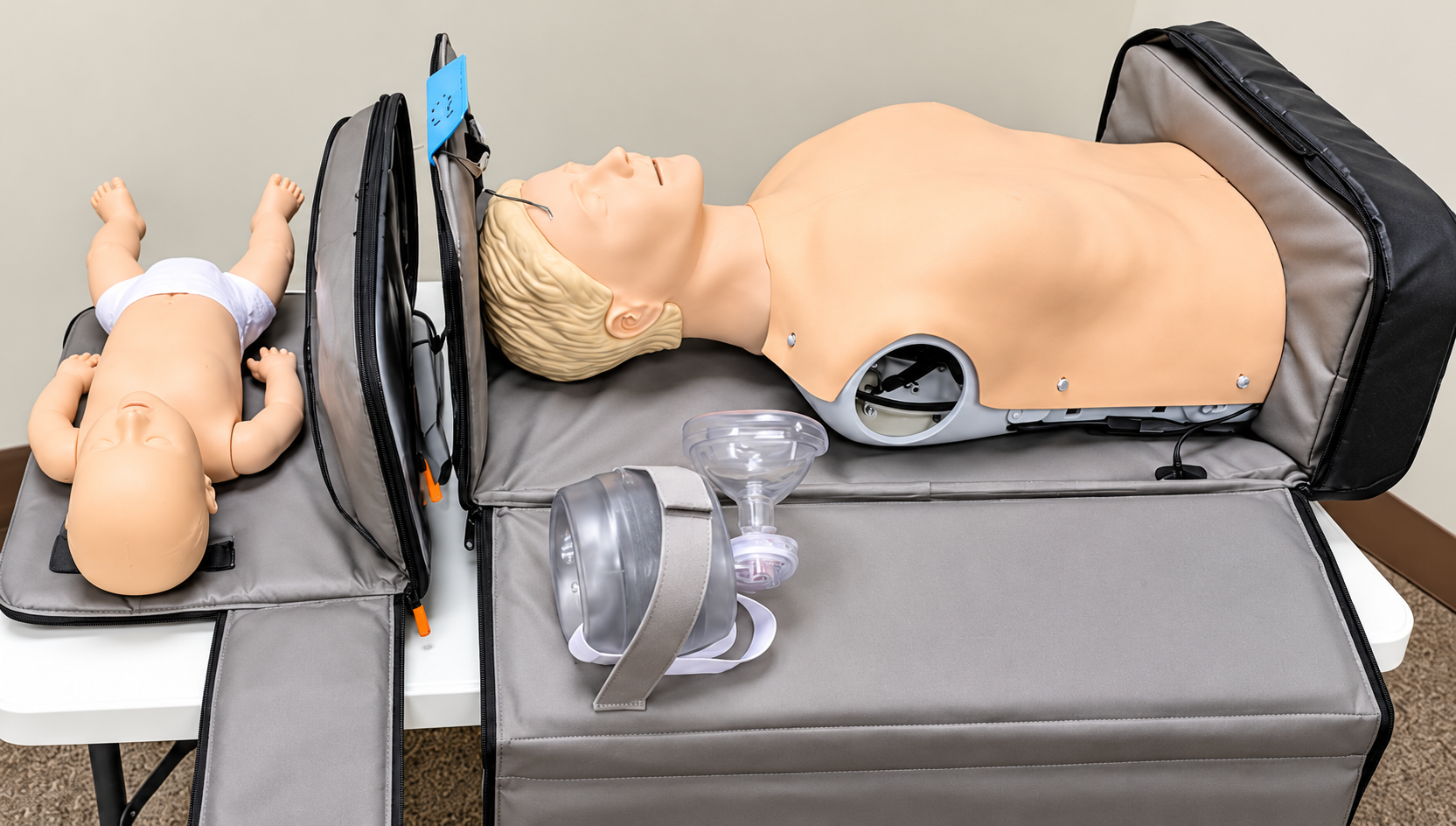
The portable setup shown in the featured image includes adult and infant CPR manikins, ventilation equipment and a portable carrying system. It is designed to make the skills-verification equipment transportable while preserving the hands-on practice experience associated with the CPR skills verification system.
How Does Portable Self-Guided Training Work?
RQI-P GO is not simply a traditional CPR classroom packed into a portable case. It is a portable skills training and verification solution that can be used as part of an eligible AHA certification pathway.
The general process begins with the participant completing the applicable AHA online coursework. The organization and Citywide CPR then coordinate the appropriate portable training arrangement. During the hands-on portion, eligible participants use the portable system to practice and perform their required skills with real-time feedback.
Citywide CPR describes the RQI-P GO system as providing real-time audio and visual feedback during CPR skills performance, including feedback related to compression depth, rate, recoil and ventilation.
The exact course, eligibility and logistics should be confirmed with Citywide CPR before an organization schedules portable training.
Complete the Applicable AHA Online Learning
For applicable blended-learning pathways, participants first complete the required AHA online coursework. This separates the knowledge-based portion of training from the hands-on skills experience.
The appropriate online course depends on the certification being pursued and the participant’s requirements. Organizations should not assume that every AHA course uses the same pathway.
Practice and Perform the Required Skills
After the applicable online requirements are completed, participants use the RQI-P GO system for the required hands-on skills experience.
The technology provides real-time feedback during performance, allowing participants to practice and perform skills while receiving system-guided information about their performance.
This is a Self-Guided skills experience rather than a traditional instructor-led classroom course.
Complete the Applicable Course Requirements
Participants must still successfully complete the applicable AHA course requirements and required skills session. Using portable equipment does not eliminate the course requirements or guarantee successful completion.
The official AHA eCard is processed the same day after successful completion of course requirements and the skills session.
Who Might Benefit From RQI-P GO?
Portable skills verification may be useful for healthcare organizations that have multiple employees who need certification or renewal but face challenges sending staff away from the workplace.
Potential organizations include hospitals, medical practices, dental organizations, clinics, nursing departments, EMS agencies and other healthcare employers. Citywide CPR specifically identifies healthcare organizations with multiple staff members, different shifts and patient-care responsibilities as potential users of its portable solution.
The value is not simply having equipment that can move. The portable approach gives organizations an opportunity to discuss whether hands-on skills verification can be coordinated closer to their employees and around their operational needs.
Healthcare Teams With Different Schedules
A healthcare organization may have employees working days, evenings, weekends or rotating shifts. Certification dates can also vary across departments.
For organizations where sending everyone to an outside training center is difficult, RQI-P GO may provide another approach to coordinating eligible skills verification at the facility.
Organizations With Multiple Certification Needs
A healthcare team may include employees who need different combinations of BLS, ACLS and PALS based on their roles and organizational requirements.
Citywide CPR provides BLS, ACLS and PALS training for healthcare staff and can discuss which portable arrangement may be appropriate for an organization’s needs.
The appropriate certification should always be based on each employee’s role and the organization’s applicable requirements rather than assuming every employee needs the same course.
RQI-P GO vs. a Fixed CPR Verification Station
Citywide CPR also operates fixed CPR Verification Station™ learning centers where eligible individuals can complete Self-Guided Skills Sessions.
With a fixed station, the employee travels to a participating Citywide CPR location for the hands-on skills appointment. Organizations can review Citywide CPR’s locations to identify participating facilities and available course options.
RQI-P GO reverses the basic logistics: instead of having eligible employees travel to a fixed station, the portable skills-verification solution can be brought to a qualifying organization’s facility.
The best choice depends on factors such as the organization’s location, employee schedules, course requirements and whether staff can reasonably leave the workplace for individual appointments.
RQI-P GO vs. Instructor-Led Onsite Training
Portable RQI-P GO and instructor-led onsite training are not the same type of training arrangement.
Instructor-led training involves an instructor guiding participants through the applicable course and hands-on learning experience. This can be appropriate when an organization specifically wants an instructor-led group session.
RQI-P GO is a portable skills training and verification solution for eligible healthcare programs. Participants complete the applicable online learning and then use the portable equipment to practice and perform their required hands-on skills with real-time feedback.
Organizations that want to discuss traditional onsite group training can use Citywide CPR’s onsite training request page to provide their training needs and organizational information.
Which Certifications Can Be Supported Through RQI-P GO?
Citywide CPR offers AHA BLS, ACLS and PALS certification and renewal for healthcare professionals, and its healthcare staff program identifies RQI-P GO as a portable option for eligible skills verification associated with these programs.
However, organizations should not assume that every course, participant or training arrangement automatically qualifies for portable RQI-P GO skills verification.
Course requirements, eligibility and the appropriate format should be confirmed with Citywide CPR before scheduling.
BLS
BLS provides foundational life-support training for eligible healthcare professionals. Organizations with employees who require AHA BLS can discuss whether portable skills verification is appropriate for their training arrangement.
ACLS
ACLS is intended for eligible healthcare professionals who need advanced cardiovascular life-support training. Organizations coordinating ACLS should confirm the applicable course and skills requirements for their employees.
PALS
PALS is designed for eligible healthcare professionals who require pediatric advanced life-support training. Organizations with pediatric-care responsibilities should confirm the applicable PALS pathway and whether RQI-P GO is appropriate for their specific arrangement.
Can RQI-P GO Be Used at an Organization’s Facility?
Potentially, depending on the organization and training arrangement.
Citywide CPR’s onsite training information describes RQI-P GO as a portable solution that can be brought to an organization, while its healthcare staff program invites organizations to request information about the system.
That does not mean an organization should assume the equipment can simply be shipped anywhere and operated without coordination.
Before scheduling, organizations should discuss their location, course requirements, participant numbers, equipment setup, technical considerations, scheduling needs and other applicable requirements with Citywide CPR.
Can RQI-P GO Equipment Be Shipped to a Facility?
Shipping may be an option in some training arrangements, but organizations should request a quote and confirm the requirements rather than assuming the equipment can be shipped anywhere without setup or support.
Citywide CPR’s onsite training information describes a portable RQI-P GO option and its healthcare staff resources encourage organizations to inquire about available arrangements.
If your organization is interested in a shipping arrangement, provide Citywide CPR with information about your facility, the number of participants, the certifications needed and your preferred schedule. The training team can then determine whether the arrangement is appropriate and explain the applicable requirements.
What Makes Portable Skills Verification Different?
The primary distinction is where the hands-on skills experience takes place.
With a fixed CPR Verification Station, an eligible participant travels to a participating Citywide CPR location. With RQI-P GO, an organization can explore bringing the portable skills-verification system to its facility.
That distinction can matter for healthcare employers trying to coordinate certification around patient care, staffing coverage and employee schedules.
At the same time, RQI-P GO is not intended to replace every type of CPR training. Some organizations may be better served by instructor-led onsite training, while others may prefer to have employees complete individual Self-Guided Skills Sessions at participating Citywide CPR locations.
How Can an Organization Ask About RQI-P GO?
Organizations interested in portable training should provide enough information for Citywide CPR to understand the proposed arrangement.
Useful information includes the organization’s location, approximate number of participants, certifications needed, whether employees need initial certification or renewal, preferred scheduling and any other operational considerations that could affect the training.
Citywide CPR’s healthcare staff training page provides information about portable RQI-P GO and a way for organizations to request training information.
Organizations can also review Citywide CPR’s onsite training options when comparing portable skills verification with other workplace training arrangements.
Frequently Asked Questions About RQI-P GO
What is Citywide CPR’s RQI-P GO portable training system?
RQI-P GO is a portable CPR skills training and verification solution designed for eligible healthcare training arrangements. It allows Citywide CPR to explore bringing applicable hands-on skills verification closer to a qualifying organization’s employees.
Is RQI-P GO the same as instructor-led CPR training?
No. RQI-P GO is a portable Self-Guided skills training and verification solution, not a traditional instructor-led classroom course. Participants complete applicable online learning and use the system for the required hands-on skills experience with real-time feedback.
Does the portable system include hands-on CPR practice?
Yes, for applicable eligible programs, the portable system is used for the required hands-on skills experience. Participants practice and perform the required skills using the system and its real-time feedback capabilities.
Can healthcare organizations inquire about portable training for employees?
Yes. Healthcare organizations can contact Citywide CPR to discuss their training needs, participant numbers, location and scheduling requirements. The appropriate arrangement depends on the organization’s circumstances and applicable course requirements.
Which AHA certifications are supported?
Citywide CPR offers BLS, ACLS and PALS certification and renewal, and its healthcare staff program identifies RQI-P GO as a portable option for eligible skills verification. Organizations should confirm the specific course and portable arrangement with Citywide CPR before scheduling.
Is an instructor required during an RQI-P GO Self-Guided Skills Session?
RQI-P GO is designed as a Self-Guided skills experience rather than a traditional instructor-led class. Participants follow the system’s guidance and receive real-time feedback during the hands-on experience. Citywide CPR should confirm the applicable support and operational requirements for each organizational arrangement.
Can RQI-P GO equipment be shipped to our organization?
A shipping arrangement may be possible in some circumstances, but it must be discussed and confirmed with Citywide CPR. Organizations should request a shipping quote and confirm eligibility, setup, support, scheduling and other requirements before assuming equipment can be shipped to their facility.
Can employees still train individually at a Citywide CPR location?
Yes. Organizations can choose to have eligible employees complete their online learning and schedule individual Self-Guided Skills Sessions at participating CPR Verification Station™ learning centers. Review Citywide CPR’s Self-Guided CPR Training and available locations to explore that option.
When is the official AHA eCard processed?
The official AHA eCard is processed the same day after successful completion of course requirements and the skills session.
Explore Portable RQI-P GO Training With Citywide CPR
For organizations trying to coordinate AHA certification without automatically sending every employee to an offsite training center, RQI-P GO provides another option to explore.
The portable system is designed around hands-on skills verification, real-time feedback and flexibility for qualifying healthcare organizations. Whether your team ultimately needs portable RQI-P GO, individual Self-Guided Skills Sessions or instructor-led onsite training depends on your employees, course requirements, location and scheduling needs.
If your organization is interested in exploring the Go-Bag, start with Citywide CPR’s healthcare staff BLS, ACLS and PALS training information and request information about RQI-P GO. You can also submit your requirements through the onsite training request page so the Citywide CPR team can discuss the appropriate arrangement with you.