If you’re searching for “CPR classes near me,” start by identifying the exact certification you need, then find a training option near you that provides the required course components—including hands-on skills when applicable.
The closest CPR class is not necessarily the right class for your requirement.
A healthcare professional may need American Heart Association BLS, while another clinical role may also require ACLS or PALS. Someone completing CPR training for a non-healthcare workplace may instead need CPR/AED or First Aid training.
Before registering, check the exact requirement from your employer, school, clinical program, licensing or credentialing organization, or other organization requesting your certification.
Once you know what you need, use the CPR Finder to locate available Citywide CPR training near you.
How Do I Find CPR Classes Near Me?
Finding CPR classes nearby involves more than searching for the closest training location. First identify the certification you need, then confirm that the provider offers the appropriate course and required training format.
A simple process is:
- Check your certification requirement. Determine whether you need BLS, ACLS, PALS, CPR/AED, First Aid, or another specific course.
- Check whether a specific training organization is required. Your employer or school may specifically request an American Heart Association credential.
- Determine which course components you need. For applicable blended-learning courses, this may mean Online + Skills or Skills Only.
- Confirm the hands-on requirement. Do not assume an online course alone satisfies a requirement that includes hands-on skills.
- Find a nearby training option. Use the CPR Finder to locate available Citywide CPR training near you.
- Review the appointment details before arriving. Check your location, appointment time, building instructions, and any documentation you need to bring.
This approach helps you search for CPR training near me based on the credential you actually need rather than registering for a course simply because it appears nearby.
Which CPR Certification Do I Actually Need?
The correct CPR certification depends on why you need training and which credential your employer, school, clinical program, workplace, or other organization requires.
Before choosing a class, look for the exact course name in your requirement.
| If Your Requirement Says… | Look for… |
| AHA BLS | American Heart Association BLS |
| ACLS | American Heart Association ACLS |
| PALS | American Heart Association PALS |
| CPR/AED | The applicable CPR/AED course required by your organization |
| First Aid + CPR/AED | The applicable combined First Aid, CPR and AED course |
If the requirement is unclear, confirm it before registering.
A general search for CPR certification near me can return several types of courses that are not necessarily interchangeable.
Do Healthcare Professionals Need BLS?
Many healthcare professionals and healthcare students may be required to maintain BLS, but the exact requirement depends on the person’s role and organization.
American Heart Association BLS focuses on foundational resuscitation skills, including high-quality CPR, AED use, ventilations, and team-based basic life support.
People who may encounter BLS requirements include:
- Nurses
- Nursing and other healthcare students
- Physicians and providers
- Medical assistants
- Dental professionals
- EMS personnel
- Respiratory therapists
- Allied health professionals
- Other clinical staff
These examples do not mean every person in those professions universally needs the same credential.
If your requirement specifically says AHA BLS, look for a training pathway that provides the applicable American Heart Association BLS course rather than choosing a general CPR class.
Healthcare professionals preparing for their course can also use Citywide CPR’s BLS Study Guide for review.
When Might I Need ACLS or PALS?
Some healthcare roles require ACLS or PALS in addition to—or separately from—BLS because these certifications cover different areas of advanced resuscitation care.
ACLS, or Advanced Cardiovascular Life Support, addresses advanced adult cardiovascular emergencies. Healthcare professionals involved in applicable emergency, critical, cardiac, procedural, or acute-care environments may encounter ACLS requirements.
PALS, or Pediatric Advanced Life Support, addresses advanced assessment and management of seriously ill or injured infants and children. It may be required for healthcare professionals whose roles involve applicable pediatric emergency or advanced pediatric care.
Do not assume that ACLS automatically replaces BLS or that PALS replaces another required credential.
If your role requires one of these advanced certifications, Citywide CPR provides an ACLS Study Guide and PALS Study Guide for additional preparation.
What If I Need CPR, AED or First Aid Instead of BLS?
Not everyone searching for CPR classes near them needs healthcare-provider BLS.
Some workplaces, organizations, schools, or other settings may require CPR/AED training, First Aid, or a combined First Aid/CPR/AED course rather than BLS.
This distinction is important for people outside healthcare.
For example, someone may be looking for training because of a workplace requirement involving CPR and AED skills rather than a healthcare-provider BLS credential.
The correct course depends on the requirement you were given.
If your employer says BLS, register for the applicable BLS pathway. If the requirement instead specifies CPR/AED or First Aid/CPR/AED, look for the corresponding course rather than assuming BLS is necessary.
What Should I Look for in American Heart Association CPR Classes Near Me?
If you’re specifically searching for “American Heart Association CPR classes near me” or “AHA CPR classes near me,” verify that the course you’re considering corresponds to the AHA credential your organization requires.
Before registering, ask:
- What is the exact course?
- Does it match my employer or school’s requirement?
- Does the pathway include required hands-on skills?
- Do I need online coursework first?
- Am I registering for Online + Skills or Skills Only?
- Where is the hands-on portion completed?
- What credential is issued after successful completion?
Citywide CPR is an American Heart Association Training Center offering applicable AHA certification pathways.
Can I Complete CPR Certification Online?
Some applicable course learning can be completed online, but an online course alone should not be confused with completing a certification pathway that also requires hands-on skills.
For applicable AHA blended-learning pathways, the process may include:
Online learning → required hands-on skills → successful completion → applicable AHA eCard
This is especially important when comparing nearby CPR classes with websites advertising online CPR training.
If your certification requires hands-on skills, verify how and where those skills are completed before purchasing the course.
What Is Online + Skills?
Online + Skills is appropriate when you still need both the applicable online coursework and the corresponding required hands-on skills.
For example, a participant completing an applicable HeartCode BLS pathway may complete the online learning first and then attend the required hands-on portion.
Online + Skills can simplify the process when you need the complete applicable blended-learning pathway rather than purchasing the online and hands-on portions separately.
What Is Skills Only, and Who Should Choose It?
Skills Only is for an eligible participant who has already completed the applicable online coursework and now needs the corresponding hands-on skills portion.
This distinction matters particularly for healthcare professionals completing HeartCode training.
Skills Only should not be selected simply because:
- You have taken BLS before
- You are renewing
- Your existing BLS eCard is still current
- Your previous BLS eCard expired
- You already know CPR
Instead, Skills Only is appropriate when you have completed the applicable current HeartCode online coursework required for the corresponding skills session and have the appropriate completion documentation.
Does My Existing BLS eCard Qualify Me for Skills Only?
No. An existing, previous, current, or expired BLS Provider eCard is not the same thing as having completed the applicable current HeartCode BLS online coursework required for a Skills Only pathway.
A Provider eCard documents successful completion of a prior certification course.
HeartCode completion documentation shows that you completed the applicable online coursework associated with the hands-on skills portion you are now scheduling.
If you have not completed the applicable HeartCode coursework, Online + Skills may be the appropriate pathway even if you have held BLS certification before.
What Is Self-Guided CPR Training?
Self-Guided Learning allows applicable hands-on training to be completed through technology-guided skills practice rather than a traditional instructor-led group skills session. It does not mean online-only CPR training.
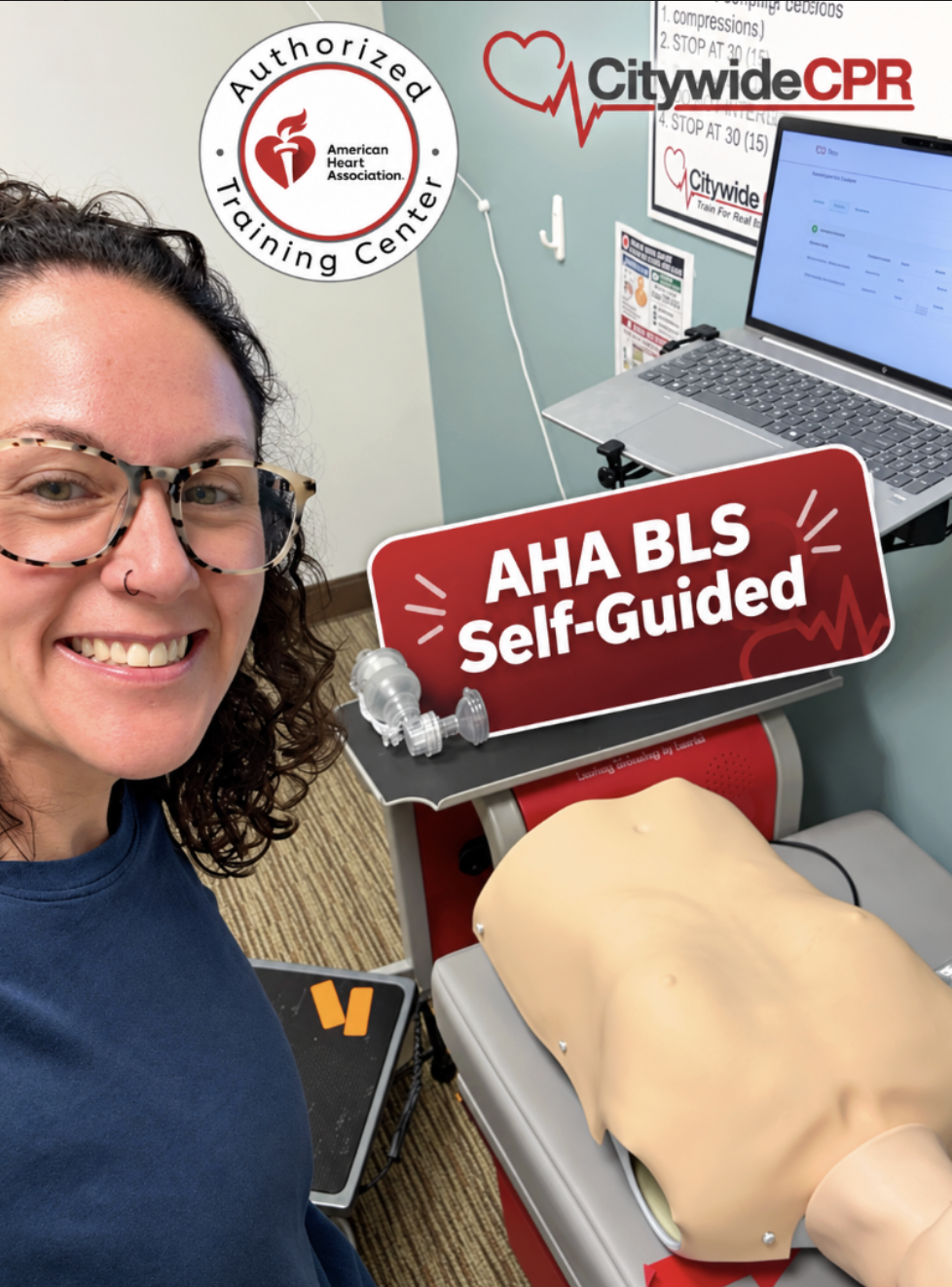
At Citywide CPR, applicable hands-on skills can be completed during a Self-Guided Skills Session at a CPR Verification Station™ learning center.
Participants physically perform applicable CPR and resuscitation skills on training equipment while the technology provides instructions and real-time performance feedback.
For a more detailed explanation of this format, visit Self-Guided CPR Training.
What Should I Expect at a Citywide CPR Skills Appointment?
When you arrive for an applicable Self-Guided Skills Session, you will use the CPR Verification Station™ learning center to complete the required hands-on portion of your course pathway.
Before arriving, review the instructions associated with your specific appointment and confirm that any required online coursework has been completed.
During an applicable session, you can expect to:
- Access your scheduled skills session.
- Follow the instructions provided through the training system.
- Perform the applicable hands-on skills using training equipment.
- Receive real-time performance feedback.
- Complete the required skills associated with your selected course pathway.
Self-Guided does not mean that hands-on practice has been removed. You still physically perform the applicable required skills.
Ready to Get CPR Certified? See What to Expect
See how Citywide CPR’s training process works before your appointment and get a better idea of what to expect from your hands-on experience. Readers who want additional skill previews can also visit the Skills Demonstration Video Library.
When Will I Receive My AHA eCard?
The applicable AHA eCard is issued after successful completion of the applicable course requirements according to current processing procedures.
Completing only the online coursework does not mean the entire certification pathway is complete when required hands-on skills remain.
Likewise, simply attending an appointment does not guarantee an eCard. The applicable required course components must be successfully completed.
Find CPR Training Near You
If you’re searching for CPR classes near you, use the CPR Finder to locate available Citywide CPR training in your area.
The CPR Finder provides a direct way to search for nearby training rather than relying on a national article to list individual cities, states, or neighborhoods.
Before selecting a location, make sure you know:
- Which course you need
- Whether American Heart Association training is specifically required
- Whether you need Online + Skills or Skills Only
- Which hands-on component applies to your course
- When you need the certification completed
This is particularly useful for searches such as:
CPR classes near me
CPR certification near me
American Heart Association CPR classes near me
AHA CPR classes near me
CPR training near me
Your location determines where you train. Your requirement determines which course you should select.
Looking for CPR Classes for Your Entire Staff?
An employer coordinating CPR training for multiple employees does not necessarily need to have every employee independently search for “CPR classes near me.”
Organizations can first determine which certifications employees require and then coordinate training based on role, certification type, and renewal dates.
For healthcare organizations, that may include employees who need:
- BLS
- BLS + ACLS
- BLS + PALS
- BLS + ACLS + PALS
- Different certification combinations based on clinical responsibilities
- Different renewal dates across the workforce
Citywide CPR can help healthcare employers, practice managers, clinical educators, administrators, and other organizations coordinate applicable American Heart Association BLS, ACLS, and PALS certification and renewal.
Depending on the training approach, employees may complete applicable online learning and schedule their Self-Guided Skills Sessions at Citywide CPR CPR Verification Station™ learning centers. Healthcare organizations that need employees to remain onsite can also explore applicable staff-training options.
Healthcare organizations can learn about CPR Training for Healthcare Staff – BLS, ACLS & PALS to explore available staff certification and renewal options.
For non-healthcare workplaces, the appropriate training may instead involve CPR/AED, First Aid, or combined First Aid/CPR/AED training depending on workplace requirements.
Quick Checklist Before Registering for CPR Classes Near You
Before clicking “register,” confirm:
- What certification do I need? BLS, ACLS, PALS, CPR/AED, First Aid, or another course?
- Does my organization specify AHA training? Check the exact requirement.
- Do I need Online + Skills or Skills Only? Choose based on the coursework you have actually completed.
- Are hands-on skills required? Verify where they will be completed.
- Is the location practical for me? Use CPR Finder to search nearby options.
- Have I reviewed my appointment instructions? Know where to go and what you need before arriving.
- What happens after completion? Confirm the applicable credential associated with your course pathway.
Taking a few minutes to verify these details can help you choose the correct course before you register.
Frequently Asked Questions
How do I find CPR classes near me?
First determine which CPR certification or course you need, then use the CPR Finder to locate available Citywide CPR training near you. Confirm the course type, hands-on requirements, and whether you need Online + Skills or Skills Only before registering.
How do I find American Heart Association CPR classes near me?
If your employer, school, or other organization specifically requires American Heart Association training, look for the exact AHA course requested. Citywide CPR is an American Heart Association Training Center, and CPR Finder can help you locate nearby training options.
What is the difference between CPR certification and BLS?
BLS is designed around basic life support skills used by healthcare professionals and other applicable personnel. General CPR/AED courses may serve different workplace or community requirements. Select the credential specifically requested by your organization.
Do nursing students need BLS or regular CPR?
Many nursing and other healthcare programs may require an AHA BLS Provider credential, but the student’s school or clinical program determines the exact requirement. Check before registering.
Can I take CPR certification completely online?
Some applicable coursework can be completed online, but online learning alone does not complete a certification pathway that also requires hands-on skills.
What does Online + Skills mean?
Online + Skills combines applicable online coursework with the corresponding required hands-on skills component.
What does Skills Only mean?
Skills Only is for an eligible participant who has already completed the applicable online coursework and needs the corresponding hands-on skills portion.
Does my current BLS card mean I can register for Skills Only?
No. A current or previous BLS Provider eCard is not the same as completion documentation for the applicable current HeartCode BLS online coursework required for a Skills Only pathway.
Are Self-Guided CPR classes hands-on?
Yes. During an applicable Citywide CPR Self-Guided Skills Session, participants physically perform required skills using training equipment while CPR Verification Station™ technology provides instructions and real-time performance feedback.
What is a CPR Verification Station™ learning center?
It is the training environment used for applicable Citywide CPR Self-Guided Skills Sessions. Participants perform hands-on skills while technology guides the session and provides real-time feedback.
When will I receive my AHA eCard?
The applicable AHA eCard is issued after successful completion of applicable course requirements according to current processing procedures.
How do I find a Citywide CPR location near me?
Use the CPR Finder to search for available Citywide CPR training near you and then select the appropriate course for your certification requirement.
Can Citywide CPR coordinate CPR training for my staff?
Yes. Healthcare organizations can explore coordinated BLS, ACLS, and PALS certification and renewal options through CPR Training for Healthcare Staff. Non-healthcare organizations may have different CPR/AED and First Aid training needs.
Find the Right CPR Class Near You
Searching “CPR classes near me” is a good starting point—but location is only one part of choosing the right training.
First determine which certification you need. Then verify the required course components, determine whether Online + Skills or Skills Only applies, and make sure any required hands-on training is included.
Citywide CPR is an American Heart Association Training Center offering applicable certification pathways with hands-on Self-Guided Skills Sessions at CPR Verification Station™ learning centers.
When you’re ready, use the CPR Finder to find available Citywide CPR training near you.