If you’re responsible for BLS, ACLS, or PALS certification for an entire healthcare staff, the challenge usually isn’t finding a CPR course. It’s finding a way to get everyone certified without creating a staffing problem.
Hospitals, medical practices, dental organizations, clinics, EMS agencies, and other healthcare employers may have employees working different shifts, certifications expiring on different dates, and clinical responsibilities that make it difficult to take an entire team away from work for one traditional class.
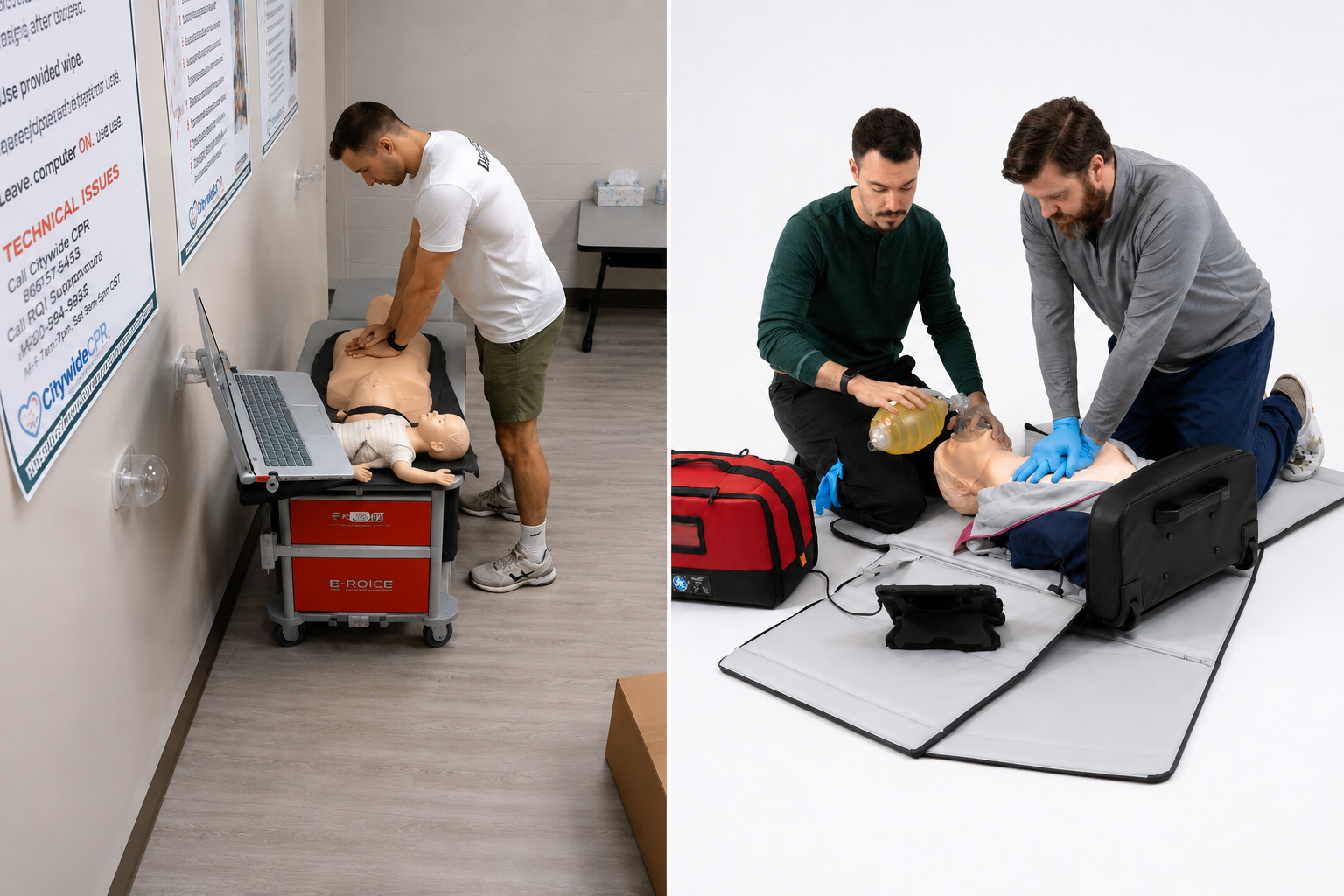
Citywide CPR gives healthcare organizations two practical options: employees can complete their required training individually at a nearby Citywide CPR CPR Verification Station, or qualifying organizations can ask Citywide CPR about bringing portable skills verification directly to their facility with RQI-P GO.
The best option depends on your team size, location, scheduling needs, and whether employees can leave the workplace.
How Do I Get My Healthcare Staff BLS, ACLS or PALS Certified?
Start by identifying who needs certification, which AHA certification each employee requires, and when their current credentials expire.
Not every employee in a healthcare organization necessarily needs the same certification.
Some employees may require American Heart Association BLS Certification. Others working in advanced cardiovascular care may also need ACLS Certification, while healthcare professionals responsible for pediatric emergencies may require PALS Certification.
Once you’ve identified those requirements, the next question is logistical:
Should employees go to a training location, or should the training solution come to your facility?
Citywide CPR can help healthcare employers with either approach through our CPR Training for Healthcare Staff – BLS, ACLS & PALS program.
Primary internal link — add naturally to the sentence above:
https://www.citywidecpr.com/cpr-training-for-healthcare-staff/
Option 1 — Send Employees to a Nearby Citywide CPR Verification Station
If you have a Citywide CPR location nearby and employees can leave the workplace individually, using a CPR Verification Station may be the simplest option.
Employees complete their required AHA online learning and then schedule a Self-Guided Skills Session at a nearby Citywide CPR Verification Station.
Rather than trying to coordinate one large class around every employee’s schedule, staff can be rotated through appointments based on their shifts and certification expiration dates.
This can work particularly well for:
- Medical offices
- Dental practices
- Smaller clinics
- Healthcare organizations with staggered renewal dates
- Employees hired throughout the year
- Departments where only a few people need renewal at a time
- Organizations located near an existing Citywide CPR Verification Station
For managers, this approach changes CPR certification from a large scheduling event into something that can be handled employee by employee.
Internal link in this section — Find a Citywide CPR Verification Station:
https://www.citywidecpr.com/locate-us/
Why Individual Skills Appointments Can Be Easier Than One Large CPR Class
Traditional group training often requires finding a date when everyone is available.
In healthcare, that can be difficult.
A nursing department may have day, evening, overnight, weekend, and per-diem employees. A medical practice may not be able to take the entire clinical team away from patients simultaneously. An EMS organization may need crews available throughout the day.
With individually scheduled skills appointments, employees can complete certification around their existing work schedules instead.
This approach can also make ongoing renewals easier. Rather than waiting until dozens of certifications are approaching expiration simultaneously, employers can direct employees to complete renewal as their individual deadlines approach.
Option 2 — Keep Staff Onsite With the Portable RQI-P GO Solution
Sometimes sending employees away from the facility simply isn’t practical.
If staff need to remain onsite or on campus, Citywide CPR can work with qualifying healthcare organizations to bring portable CPR skills verification directly to the facility using RQI-P GO.
This option is designed for organizations that need the flexibility of simulation-based skills verification without requiring employees to travel to an outside training center.
It can be especially valuable for:
- Hospitals
- Healthcare systems
- Large medical practices
- Dental organizations
- Surgery centers
- EMS agencies
- Clinics
- Healthcare organizations with multiple departments
- Facilities where staffing coverage makes offsite training difficult
Instead of asking, “How do we get everyone to CPR training?”, the organization can explore bringing the skills verification experience closer to the employees.
Internal link — Healthcare Staff Training / RQI-P GO information:
https://www.citywidecpr.com/cpr-training-for-healthcare-staff/
What Is RQI-P GO?
RQI-P GO is a portable CPR skills verification solution designed for mobile use.
For Citywide CPR’s healthcare organization partners, portability means the simulation-based skills verification experience can be brought to a qualifying hospital, medical facility, campus, or healthcare organization rather than requiring staff to travel to a stationary training location.
This can help organizations reduce employee travel and simplify scheduling while coordinating BLS, ACLS, and PALS certification and renewal for healthcare staff.
It can be particularly useful for organizations where taking nurses, physicians, respiratory therapists, EMS personnel, or other providers off campus creates staffing or operational problems.
Onsite vs. Offsite CPR Training for Employees: Which Is Better?
Neither option is automatically better. The right answer depends on your organization.
A nearby Citywide CPR Verification Station may make more sense when:
- Only a few employees need certification at once.
- Employees can leave the workplace for appointments.
- A Citywide CPR location is convenient to your facility.
- Certification expirations occur throughout the year.
- You want employees to schedule around their individual shifts.
Portable RQI-P GO may make more sense when:
- Many employees need BLS, ACLS, or PALS.
- Staff need to remain onsite or on campus.
- Taking employees away from patient care is difficult.
- Your organization wants to reduce employee travel.
- You need to coordinate training across a department or facility.
- Your healthcare organization has a larger or more complex training need.
Some organizations may even benefit from using both approaches.
Employees near a Citywide CPR location can use Verification Stations for routine individual renewals, while RQI-P GO can provide another option when larger groups or operational circumstances make onsite training more practical.
How Can a Medical Office Get Its Staff BLS Certified?
For a smaller medical office, the first step should usually be checking whether there is a Citywide CPR Verification Station nearby.
If there is, employees can complete their required online learning and schedule individual skills appointments around the practice schedule.
That can be much easier than closing the office, reducing patient appointments, or finding one date that works for the entire staff.
If the practice is larger, has multiple offices, or cannot easily send employees away from the workplace, contact Citywide CPR to discuss whether an onsite solution makes more sense.
Internal link — BLS Certification:
https://www.citywidecpr.com/bls-certification/
What About BLS Training for Dental Staff?
Dental organizations face many of the same scheduling challenges as medical practices.
Dentists, hygienists, assistants, and other team members may have certification requirements that must remain current, but taking several employees out of the practice simultaneously can disrupt patient schedules.
Where appropriate, dental organizations can rotate employees through nearby Citywide CPR Verification Stations instead of coordinating one large class.
Larger dental groups or multi-location organizations can also contact Citywide CPR about healthcare staff training options when onsite or more coordinated training is needed.
Always verify the specific certification requirements that apply to each role before registering employees.
Can Hospitals Use RQI-P GO to Keep Employees on Campus?
For qualifying organizations, this is one of the primary reasons to consider the portable option.
Hospitals have a unique problem: the people who need training are often the same people who are difficult to remove from the clinical environment.
Nursing leadership and education departments may need to maintain certification for nurses, respiratory therapists, physicians, advanced practice providers, and other employees while simultaneously maintaining appropriate staffing.
Bringing portable skills verification to the facility can reduce the need for staff to travel away from campus.
Healthcare organizations interested in this approach should contact Citywide CPR with their approximate number of employees, certifications needed, facility location, and training goals so the appropriate solution can be discussed.
Can Citywide CPR Help With BLS, ACLS and PALS for the Same Organization?
Yes.
Citywide CPR provides American Heart Association certification and renewal options for healthcare professionals, including:
BLS Certification
Basic Life Support for healthcare professionals and other individuals whose roles require BLS.
ACLS Certification
Advanced Cardiovascular Life Support for appropriate healthcare professionals involved in cardiovascular emergencies.
PALS Certification
Pediatric Advanced Life Support for appropriate healthcare professionals involved in pediatric emergency care.
A single healthcare organization may have employees who require different combinations of these credentials.
Rather than treating BLS, ACLS, and PALS as three unrelated training problems, employers can work with Citywide CPR to determine how employees can complete the certifications required for their roles.
How Can Healthcare Organizations Manage Expiring CPR Certifications?
Don’t wait until an entire department’s certifications have expired.
A more manageable strategy is to track expiration dates and begin directing employees toward renewal before their credentials lapse.
For organizations near Citywide CPR locations, this can mean sending employees individually to Verification Stations as renewal dates approach.
For organizations with larger groups or employees who need to remain onsite, it may be worth discussing a portable RQI-P GO solution before a major renewal cycle arrives.
The objective is to make certification part of routine workforce planning rather than an emergency every time multiple credentials approach expiration.
What Should I Send Citywide CPR When Requesting Staff Training?
You don’t need to design the training program yourself before contacting Citywide CPR.
It helps to provide:
- Organization name
- City and state
- Approximate number of employees
- BLS, ACLS, and/or PALS requirements
- Whether employees can leave the facility
- Whether you have multiple locations
- Approximate certification deadlines
- Any specific scheduling concerns
Citywide CPR can then help determine whether your staff would be better served by nearby Verification Stations, portable RQI-P GO skills verification, or a combination of approaches.
Internal link — CPR Training for Healthcare Staff – BLS, ACLS & PALS:
https://www.citywidecpr.com/cpr-training-for-healthcare-staff/
Frequently Asked Questions About BLS, ACLS & PALS Training for Healthcare Staff
How do I get my entire healthcare staff BLS certified?
Start by identifying which employees require BLS and their certification deadlines. If a Citywide CPR Verification Station is nearby, employees can complete required online learning and schedule Self-Guided Skills Sessions around their shifts. Qualifying organizations that need staff to remain onsite can ask Citywide CPR about portable RQI-P GO skills verification.
Can BLS training come to our healthcare facility?
Yes. Citywide CPR offers portable skills verification options through RQI-P GO for qualifying healthcare organizations where sending employees off campus is difficult.
Do all of our employees have to attend CPR training at the same time?
Not necessarily. One advantage of Citywide CPR Verification Stations is that employees can schedule individual skills appointments around their shifts and certification expiration dates rather than requiring the organization to coordinate one large traditional class.
Can Citywide CPR train hospital staff in BLS, ACLS and PALS?
Citywide CPR provides American Heart Association BLS, ACLS, and PALS certification and renewal options for healthcare professionals. Organizations can use nearby Verification Stations or discuss portable onsite skills verification depending on their needs.
Is onsite or offsite BLS training better for a medical office?
For a smaller practice near a Citywide CPR location, individual Verification Station appointments may be the simplest solution. Larger practices, multi-location organizations, or facilities where employees cannot easily leave work may benefit from discussing portable onsite training.
Can dental staff use Citywide CPR Verification Stations?
Yes, when the certification offered matches the employee’s requirements. Dental organizations near a Citywide CPR location can send employees individually for scheduled skills appointments, helping reduce disruption to patient schedules.
How do I decide whether our organization needs RQI-P GO?
Consider RQI-P GO when many employees require certification, staff need to remain onsite, employee travel is difficult, or coordinating offsite appointments would create operational problems. Citywide CPR can review your organization’s needs and help determine which approach makes the most sense.
Conclusion
Getting an entire healthcare staff BLS, ACLS, or PALS certified doesn’t have to mean taking everyone off the floor for one large training day.
For healthcare organizations near a Citywide CPR location, employees can complete required online learning and rotate through individually scheduled Verification Station appointments. This can work especially well for medical practices, dental organizations, clinics, and employers with staggered certification expiration dates.
When staff need to remain onsite or on campus, qualifying organizations can ask Citywide CPR about the portable RQI-P GO solution, bringing CPR skills verification closer to the workforce instead of sending employees away from the facility.
The right approach depends on your organization. Citywide CPR can help you determine which option—or combination of options—best fits your staff, facility, and certification schedule.
Need a better way to manage BLS, ACLS, or PALS certification for your healthcare staff?
Start with Citywide CPR’s dedicated healthcare staff training resource. Learn how your employees can use nearby CPR Verification Stations or ask about bringing portable RQI-P GO skills verification to your organization.
CPR Training for Healthcare Staff – BLS, ACLS & PALS
https://www.citywidecpr.com/cpr-training-for-healthcare-staff/
For individual course information:
BLS Certification
https://www.citywidecpr.com/bls-certification/
ACLS Certification
https://www.citywidecpr.com/acls-certification/
PALS Certification
https://www.citywidecpr.com/pals-certification/
Find a Citywide CPR Verification Station
https://www.citywidecpr.com/locate-us/