Both Self-Guided Learning and traditional instructor-led CPR training can include required hands-on CPR skills. The primary difference is how the learning and skills experience is delivered.
With Self-Guided Learning, eligible participants complete the applicable learning requirements and then independently perform hands-on skills during a Self-Guided Skills Session at a CPR Verification Station. Technology provides instructions and real-time performance feedback as the participant works through the session.
With traditional instructor-led CPR training, an instructor leads the course experience, demonstrates applicable skills, coaches participants and evaluates their performance.
The most important distinction is this:
Self-Guided does not mean online-only.
Self-Guided does not mean there is no hands-on skills requirement.
Both formats can involve physically performing CPR and other required skills. The difference is primarily who or what guides the participant through that experience.
What Is Self-Guided CPR Training?
Self-Guided CPR Training is a learning format in which technology guides eligible participants through applicable hands-on CPR or resuscitation skills rather than relying on continuous instructor-led group instruction.
At Citywide CPR, applicable Self-Guided Skills Sessions take place at CPR Verification Stations.
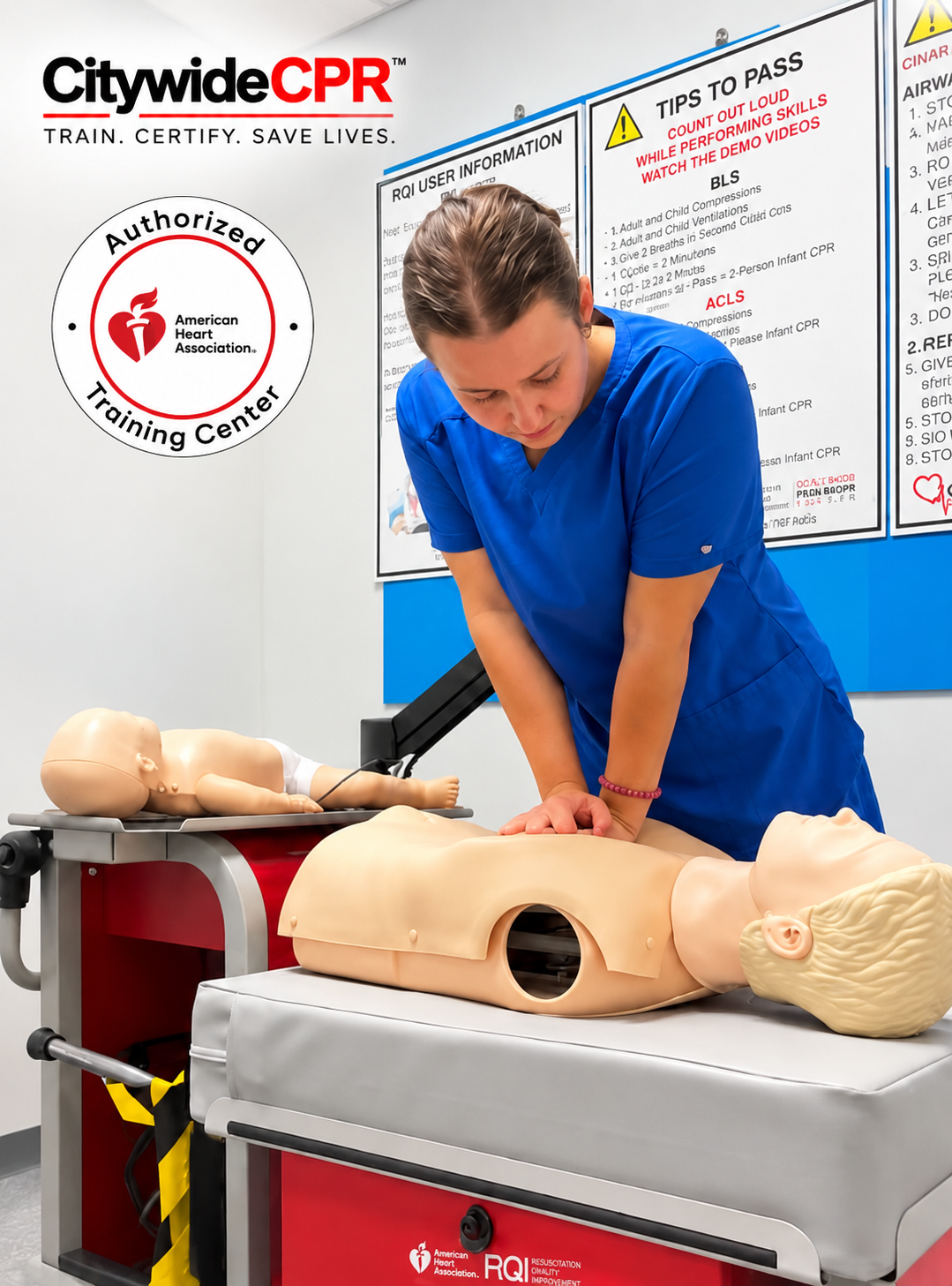
Participants physically perform the required skills on training manikins while the station provides instructions and performance feedback.
That is the short version.
For a complete explanation of the format, read What Is Self-Guided CPR Training? How American Heart Association Self-Guided Learning Works rather than duplicating that entire topic here.
What Is Traditional Instructor-Led CPR Training?
Traditional instructor-led CPR training is conducted with an instructor who guides the participant or class through the required learning and hands-on skills experience.
Depending on the course format, the instructor may:
- Explain course concepts
- Demonstrate applicable skills
- Guide practice
- Observe participant performance
- Provide coaching and corrections
- Evaluate required skills
Participants may complete the course individually or as part of a group, depending on the provider and training setup.
Unlike a Self-Guided Skills Session, the instructor is physically involved in leading and evaluating the hands-on experience.
Is Self-Guided CPR Really Hands-On?
Yes.
This is one of the most important misconceptions to clear up.
Self-Guided Learning is not the same as taking a CPR course entirely online and never touching a manikin.
During an applicable Self-Guided Skills Session, the participant physically performs the required hands-on skills using training manikins and Verification Station equipment.
The technology changes how the participant is guided and evaluated.
It does not remove the practical component.
So the comparison is not:
Online CPR vs. hands-on CPR
It is more accurately:
Technology-guided hands-on training vs. instructor-guided hands-on training
How Does a Self-Guided Skills Session Work?
At Citywide CPR, the participant arrives for a scheduled appointment at a CPR Verification Station and completes the applicable skills individually.
The station provides instructions and feedback while the participant performs the required tasks.
The participant progresses through the session based on the applicable course requirements rather than waiting for an entire classroom to move through each step together.
For an eligible blended-learning pathway, the overall structure may look like:
Applicable online learning → Self-Guided Skills Session → successful course completion
That combination is one reason people sometimes describe the format using search terms such as self-paced CPR or instructorless CPR.
However, Citywide CPR uses the current terminology Self-Guided Learning and Self-Guided Skills Session because those terms more accurately describe the experience.
What Is the Role of a CPR Verification Station?
A CPR Verification Station is the technology-based training setup used during applicable Self-Guided Skills Sessions.
The participant uses training manikins and the station equipment to complete hands-on skills while receiving instructions and performance feedback.
For the purposes of this comparison, the key distinction is simple:
In a Self-Guided session, the Verification Station helps guide the skills experience.
In an instructor-led course, the instructor guides the skills experience.
If you want a full explanation of what happens when you arrive, how the station works and what the experience feels like, read What Is a CPR Verification Station? What to Expect During Your Skills Session.
How Is Skills Feedback Different?
Both formats can provide feedback on hands-on performance, but the source of that feedback differs.
Self-Guided Learning
During applicable skills, technology provides real-time audio and visual feedback based on the participant’s performance.
The participant can respond to that feedback while working through the session.
Instructor-Led Training
An instructor observes the participant, provides coaching and evaluates applicable skills as part of the training experience.
Neither format should automatically be described as more accurate, harder, easier or more effective simply because the source of feedback is different.
The important distinction is technology-guided feedback versus instructor-led coaching and evaluation.
How Is the Pacing Different?
Self-Guided Learning generally creates a more individualized experience.
The participant progresses through the applicable skills session directly with the Verification Station rather than moving through each activity with an entire traditional class.
Instructor-led training may be paced according to the instructor, course structure and other participants in the class.
That does not mean every instructor-led class is slow or every Self-Guided session is fast.
It simply means the pacing model is different.
For learners who prefer to focus on their own session rather than participate in a group classroom experience, the Self-Guided format may be appealing.
Others may prefer the social interaction and direct instructor communication of a traditional class.
How Is Scheduling Different?
Scheduling is another practical difference.
At Citywide CPR, Self-Guided Learning allows eligible participants to schedule hands-on appointments at CPR Verification Stations rather than relying only on traditional group class times.
That can provide greater flexibility for healthcare professionals balancing:
- Hospital shifts
- Clinic schedules
- School or clinical rotations
- Patient care
- On-call responsibilities
- Certification deadlines
Traditional instructor-led availability depends on the training provider and its scheduled classes.
It would be inaccurate to say that instructor-led training is always less flexible. Some providers may offer many class options.
The distinction is that Citywide CPR’s Verification Station model is specifically designed to support individual scheduled Self-Guided Skills Sessions.
Self-Guided CPR vs. Instructor-Led CPR: Quick Comparison
| Topic | Self-Guided Learning | Instructor-Led Training |
| Learning format | Applicable online learning + Self-Guided Skills Session | Instructor-led course format |
| Hands-on skills | Yes | Yes |
| Skills feedback | Technology provides real-time feedback | Instructor evaluates and coaches skills |
| Pacing | More individually paced | Instructor/class paced |
| Scheduling | Can provide greater scheduling flexibility | Depends on scheduled class availability |
| Instructor physically present during skills | Not during the Self-Guided Skills Session | Yes |
| Group classroom required | No, for applicable Self-Guided pathways | Often part of the traditional format |
| Training manikins used | Yes, for applicable hands-on skills | Yes, for applicable hands-on skills |
Neither column represents a universally “better” form of CPR training.
The right choice depends on the course you need, the available training pathway and how you prefer to learn.
Can BLS Be Completed Through Self-Guided Learning?
Yes. Citywide CPR offers applicable American Heart Association BLS Certification pathways using Self-Guided Learning.
Depending on the option selected, participants may complete HeartCode BLS online learning before attending their hands-on Self-Guided Skills Session.
This is especially relevant for healthcare professionals who want the flexibility of completing applicable learning independently and scheduling the hands-on portion separately.
Because Citywide CPR already has dedicated articles explaining Self-Guided BLS, BLS renewal and BLS Skills Only, those topics do not need to be repeated in detail here.
Can ACLS Be Completed Through Self-Guided Learning?
Citywide CPR offers applicable ACLS Certification pathways using Self-Guided Learning as well.
As with BLS, the participant completes the applicable course requirements and hands-on skills for that specific certification pathway.
ACLS is not simply BLS performed at a Verification Station; it has its own course requirements and should be selected only when the participant needs ACLS.
Can PALS Be Completed Through Self-Guided Learning?
Citywide CPR also offers applicable PALS Certification pathways using Self-Guided Learning.
PALS has its own requirements related to pediatric advanced life support, so it should not be treated as interchangeable with BLS or ACLS.
The point for this comparison is that Self-Guided Learning is not limited to BLS.
Eligible BLS, ACLS and PALS pathways can use this technology-guided training format.
Is Self-Guided CPR the Same as “Instructorless CPR”?
People sometimes search for terms such as instructorless CPR, self-paced CPR, or self-guided CPR certification.
Those phrases generally reflect the same question: can CPR or BLS training be completed without an instructor physically leading the hands-on session?
For applicable Self-Guided Learning pathways, the answer is yes—the Verification Station technology guides the participant through the hands-on skills experience.
However, “instructorless CPR” can sound as though no instruction or evaluation exists.
That is misleading.
The participant still receives instructions and performance feedback. The guidance simply comes through the Self-Guided Learning technology rather than continuous instructor-led classroom instruction.
Who May Prefer Self-Guided Learning?
Self-Guided Learning may appeal to someone who:
- Prefers an individualized training environment
- Wants to complete applicable learning independently
- Likes technology-guided feedback
- Does not need a traditional classroom setting
- Has a healthcare work schedule that makes fixed group classes difficult
- Prefers scheduling an individual hands-on appointment
- Is comfortable following on-screen and audio instructions during hands-on training
For experienced healthcare professionals, the ability to complete a session individually may be particularly attractive.
That does not mean Self-Guided Learning is automatically the right choice for every learner.
Who May Prefer Instructor-Led CPR Training?
Instructor-led training may appeal to someone who:
- Prefers direct interaction with an instructor
- Likes asking questions during the course
- Learns best through live discussion
- Prefers demonstrations led in person
- Enjoys a traditional classroom environment
- Is more comfortable practicing with an instructor physically present
Someone taking CPR for the first time may personally prefer this format, while another first-time learner may be completely comfortable with technology-guided training.
Learning preference varies from person to person.
Is Self-Guided CPR Better Than Instructor-Led CPR?
Neither format is universally better.
They are different methods of delivering applicable CPR and resuscitation training.
Self-Guided Learning offers an individualized, technology-guided experience with real-time feedback and can provide scheduling flexibility.
Instructor-led training provides direct interaction with an instructor who leads, coaches and evaluates the training experience.
The better choice is the one that:
- Meets the certification requirements you actually have
- Is available for the course you need
- Fits your learning preference
- Works with your schedule
- Produces the credential required by your employer, school or organization
Avoid choosing a format based only on whether someone describes it as “easier” or “faster.”
The goal should be completing the correct training pathway successfully.
How Do I Choose Between Self-Guided and Instructor-Led CPR Training?
Start with your certification requirement.
Ask:
What certification do I actually need?
If your employer or school requires BLS, determine whether an applicable Self-Guided BLS pathway is acceptable for that credential.
Then consider your preferred learning environment.
If you value individual pacing, technology-guided feedback and flexible appointment scheduling, Self-Guided Learning may be a strong fit.
If you prefer direct interaction with an instructor throughout your hands-on training, traditional instructor-led training may be a better fit.
The training format should come after determining the correct certification requirement—not before.
How Does Citywide CPR Provide Self-Guided Learning?
Citywide CPR provides applicable Self-Guided Learning through a nationwide network of CPR Verification Stations.
Participants complete the appropriate course pathway and schedule their Self-Guided Skills Session at a convenient location.
During the hands-on portion, participants physically perform applicable skills using training manikins while the station technology provides instructions and feedback.
This is not simply an informational concept Citywide CPR writes about.
It is a training format Citywide CPR uses every day to help healthcare professionals and students complete applicable BLS, ACLS and PALS requirements.
For a complete overview of available options, visit Citywide CPR’s Self-Guided CPR Training resource.
Where Can I Find Self-Guided CPR Training Near Me?
If Self-Guided Learning sounds like the right fit, the next step is to determine which certification you need.
Citywide CPR offers Verification Stations at locations nationwide.
After selecting the appropriate BLS, ACLS or PALS pathway, you can use the location finder to identify a convenient CPR Verification Station and review appointment availability.
Find a Citywide CPR Verification Station near you:
https://www.citywidecpr.com/locate-us/
Frequently Asked Questions
What is the main difference between Self-Guided CPR and instructor-led CPR?
The main difference is how the training experience is delivered. Self-Guided Learning uses technology to guide applicable hands-on skills at a CPR Verification Station, while instructor-led training uses an instructor to lead, coach and evaluate the course experience.
Is Self-Guided CPR the same as online CPR?
No. Self-Guided Learning can include applicable online coursework, but the Self-Guided Skills Session is hands-on. Participants physically perform required skills using training manikins and Verification Station equipment.
Is Self-Guided CPR hands-on?
Yes. Self-Guided CPR includes applicable hands-on skills. “Self-Guided” describes how the participant is guided through the session; it does not mean the hands-on portion is eliminated.
Is an instructor present during a Self-Guided Skills Session?
The Self-Guided Skills Session is designed to use Verification Station technology to provide instructions and performance feedback rather than having an instructor physically lead the hands-on session.
What is a CPR Verification Station?
A CPR Verification Station is a technology-based training setup that uses training manikins and feedback systems to guide participants through applicable hands-on skills during a Self-Guided Skills Session.
How is feedback different in Self-Guided CPR?
Self-Guided Learning uses technology to provide real-time audio and visual performance feedback. In traditional instructor-led training, the instructor observes, evaluates and coaches the participant.
Is Self-Guided CPR more flexible?
Citywide CPR’s Self-Guided Learning model can provide greater scheduling flexibility because eligible participants can schedule individual hands-on appointments at Verification Stations. Instructor-led availability varies by training provider.
Can I complete BLS through Self-Guided Learning?
Yes. Citywide CPR offers applicable American Heart Association BLS training pathways using Self-Guided Learning and CPR Verification Stations.
Can ACLS be completed through Self-Guided Learning?
Citywide CPR offers applicable ACLS pathways using Self-Guided Learning. Participants must complete the requirements associated with the ACLS course they select.
Can PALS be completed through Self-Guided Learning?
Yes. Citywide CPR offers applicable PALS pathways using Self-Guided Learning and Verification Station-based hands-on skills.
Is “instructorless CPR” the same as Self-Guided Learning?
People may use “instructorless CPR” when searching for this format, but Self-Guided Learning is the clearer terminology. The participant still receives instructions and performance feedback; the guidance comes through technology rather than continuous instructor-led training.
Is Self-Guided CPR easier than instructor-led CPR?
It should not be described as universally easier. Both formats require participants to successfully complete the applicable course requirements. The primary difference is how the learning and hands-on skills experience is delivered.
Who should choose Self-Guided CPR?
Self-Guided Learning may suit participants who prefer an individualized experience, technology-guided feedback and flexible scheduling. The appropriate training format also depends on the certification required by the participant’s employer, school or organization.
Who should choose instructor-led CPR?
Instructor-led training may be preferable for someone who values direct instructor interaction, live questions and answers, classroom demonstrations and instructor-guided hands-on practice.
How do I choose between Self-Guided and instructor-led CPR?
First determine which certification you need. Then compare available training pathways, your learning preference, scheduling needs and any requirements established by your employer or school.
Which CPR Training Format Is Right for You?
If you prefer an individualized hands-on experience with technology-guided feedback and flexible appointment scheduling, Citywide CPR’s Self-Guided Learning options may be a good fit.
Learn how the training model works:
Self-Guided CPR Training
https://www.citywidecpr.com/self-guided-cpr-training/
Then choose the certification you need:
BLS Certification
https://www.citywidecpr.com/bls-certification/
ACLS Certification
https://www.citywidecpr.com/acls-certification/
PALS Certification
https://www.citywidecpr.com/pals-certification/
Ready to find a convenient hands-on location?
Find a Citywide CPR Verification Station Near You
https://www.citywidecpr.com/locate-us/