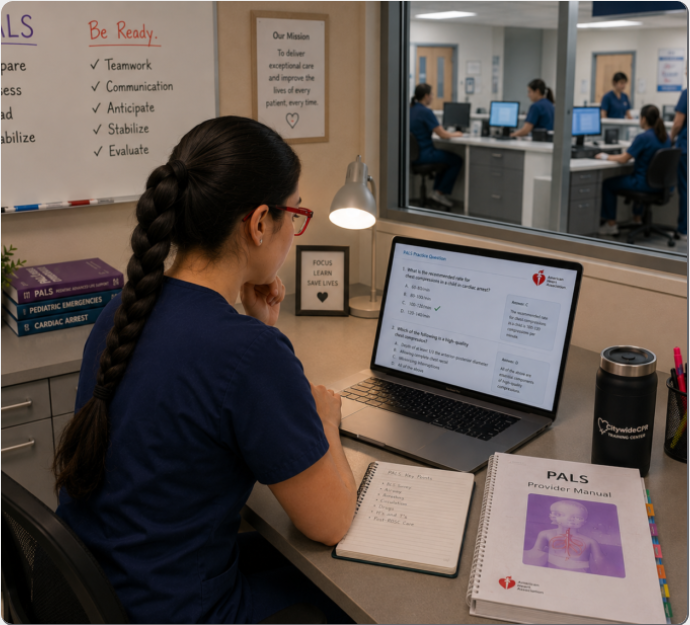
Preparing for American Heart Association (AHA) Pediatric Advanced Life Support (PALS) Certification involves much more than learning pediatric CPR techniques. Healthcare professionals caring for infants and children must be prepared to recognize life-threatening emergencies, perform rapid patient assessments, communicate effectively with the healthcare team, and provide evidence-based pediatric emergency care.
The HeartCode PALS eLearning course introduces these foundational concepts before participants demonstrate their hands-on skills during an in-person verification session. Reviewing the material before your course can improve confidence, reinforce key concepts, and help you arrive better prepared for certification. This study guide is designed to supplement—but not replace—the official American Heart Association course materials.
What Is Pediatric Advanced Life Support (PALS)?
Pediatric Advanced Life Support (PALS) is an advanced certification program developed by the American Heart Association to prepare healthcare professionals to recognize, assess, and respond to pediatric emergencies.
Unlike Basic Life Support, PALS focuses on the specialized care of infants and children experiencing respiratory distress, shock, cardiac arrest, and other life-threatening conditions. The course emphasizes early recognition, systematic patient assessment, effective communication, teamwork, and evidence-based treatment strategies.
By combining online learning with a hands-on skills session, PALS helps providers develop the knowledge and practical abilities needed to care for critically ill pediatric patients.
Who Needs American Heart Association PALS Certification?
PALS Certification is commonly required for healthcare professionals who care for pediatric patients or may respond to pediatric emergencies.
Healthcare professionals frequently requiring PALS Certification include:
- Registered Nurses (RNs)
- Physicians
- Nurse Practitioners
- Physician Assistants
- Respiratory Therapists
- Paramedics
- Emergency Department Staff
- Pediatric Intensive Care Unit (PICU) Staff
- Pediatric Healthcare Professionals
Many hospitals and pediatric specialty departments require current American Heart Association PALS Certification as part of employment or credentialing requirements.
What You’ll Learn During HeartCode PALS
The HeartCode PALS eLearning course introduces healthcare professionals to the concepts needed to evaluate and manage pediatric emergencies.
Topics commonly covered include:
- Pediatric patient assessment
- Pediatric rhythm recognition concepts
- High-quality pediatric CPR
- Pediatric airway management
- Team communication
- Recognition of pediatric emergencies
- Post-cardiac arrest care concepts
Each lesson is designed to strengthen clinical decision-making while reinforcing current American Heart Association pediatric emergency cardiovascular care guidelines.
How to Prepare Before Your PALS Skills Session
Reviewing pediatric emergency care concepts before beginning your HeartCode PALS course helps improve confidence and reinforces important clinical principles.
Before attending your appointment, it’s recommended that you:
- Complete the HeartCode PALS eLearning course.
- Review Pediatric Basic Life Support concepts.
- Become familiar with pediatric patient assessment.
- Refresh pediatric rhythm recognition concepts.
- Arrive prepared to demonstrate high-quality CPR skills.
The in-person PALS skills session focuses primarily on demonstrating high-quality CPR skills rather than reviewing advanced pediatric concepts in detail, making preparation especially valuable.
Key Concepts Every PALS Provider Should Remember
Several core principles form the foundation of Pediatric Advanced Life Support.
Healthcare professionals should remember that:
- PALS concepts are introduced during the HeartCode PALS eLearning course.
- Pediatric patient assessment is one of the most important components of emergency care.
- Effective teamwork and communication improve pediatric resuscitation outcomes.
- The in-person PALS skills session emphasizes demonstrating high-quality CPR skills.
These concepts help providers recognize deteriorating pediatric patients early and respond using coordinated, evidence-based care.
Why Healthcare Professionals Choose Citywide CPR
Citywide CPR offers flexible scheduling designed for busy healthcare professionals who need official American Heart Association PALS Certification.
Participants benefit from:
- Official American Heart Association PALS Certification
- HeartCode PALS Online + Skills
- Self-guided PALS skills sessions
- Flexible daily appointments
- Convenient nationwide locations
- Same-Day AHA eCards after successful completion
- Simulation-based training using American Heart Association-compliant technology
Whether you’re renewing your certification or completing PALS for the first time, Citywide CPR provides a convenient certification experience designed around your schedule.
Frequently Asked Questions
Who should complete PALS Certification?
PALS Certification is commonly required for nurses, physicians, respiratory therapists, paramedics, emergency department staff, pediatric ICU providers, and other healthcare professionals who care for infants and children.
What topics are covered during HeartCode PALS?
The course covers pediatric assessment, rhythm recognition, pediatric CPR, airway management, communication, pediatric emergencies, and post-cardiac arrest care concepts.
How long is American Heart Association PALS Certification valid?
American Heart Association PALS Certification is typically valid for two years.
Do I need to complete the online course before my skills session?
Yes. Participants should complete the HeartCode PALS eLearning course before attending their hands-on skills verification appointment.
What is the focus of the in-person PALS skills session?
The in-person session focuses on demonstrating high-quality CPR skills while applying the principles learned during the HeartCode PALS course.
Conclusion
Preparing before your American Heart Association PALS Certification helps strengthen your understanding of pediatric emergency care while building confidence for your skills session. Reviewing pediatric assessment, airway management, CPR concepts, and team communication before certification helps healthcare professionals develop the knowledge needed to respond effectively during pediatric emergencies.
Whether you’re beginning your pediatric healthcare career or renewing your certification, preparation supports better learning and better patient care.
Ready to complete your American Heart Association PALS Certification?
Citywide CPR offers flexible daily appointments, HeartCode PALS Online + Skills, self-guided pediatric skills sessions, convenient nationwide locations, and Same-Day AHA eCards after successful completion.
Register today and prepare confidently for your next Pediatric Advanced Life Support certification. Locate us.