How Can a Medical Clinic Schedule BLS, ACLS or PALS Training With Minimal Disruption?
Coordinating certification for a medical clinic is not simply a matter of finding a class with enough seats. A clinic may have nurses, providers, clinical staff, and other employees working different shifts, with different certification expiration dates and different training requirements.
For a manager responsible for certification, the challenge is often how to keep staff current without taking the entire team away from patients at the same time.
A practical solution is to build a training plan around the clinic’s actual staffing schedule. Depending on employee requirements and organizational needs, a medical clinic can combine online learning with required hands-on skills, schedule employees individually, coordinate group training, or explore onsite skills verification.
Citywide CPR is an American Heart Association Training Center offering BLS, ACLS and PALS certification and renewal options for healthcare organizations. Its healthcare staff program provides both off-campus Self-Guided Skills Session options and portable onsite skills verification through RQI-P GO. Citywide CPR
What Is the Best Way to Schedule BLS, ACLS or PALS Training for a Medical Clinic?
The most practical approach is usually to match the training format to the clinic’s staffing situation rather than requiring every employee to train in exactly the same way and at the same time.
A clinic can begin by identifying:
- Which employees need BLS, ACLS, or PALS.
- Which employees are completing initial certification versus renewal.
- When each employee’s current certification expires.
- Which employees need the applicable online coursework.
- Which employees have already completed the applicable online course and only need the hands-on skills portion.
- Whether employees can leave the clinic for individual appointments.
- Whether onsite training would better fit the organization’s schedule.
This creates a training plan that accounts for both certification requirements and the realities of operating a medical clinic.
How Can a Clinic Minimize Time Away From Patient Care?
Clinics can minimize disruption by staggering employee training, using flexible skills appointments, and considering onsite options when employee travel is impractical.
For example, instead of scheduling 20 employees for one large training session, a clinic could divide the staff into smaller groups or schedule employees individually around their shifts.
This can be particularly useful when employees have:
- Different shifts
- Different days off
- Different certification expiration dates
- Different certification requirements
- Different levels of training already completed
The goal is not necessarily to make every employee follow the same schedule. The goal is to keep certification management organized while maintaining appropriate staffing levels.
Can Employees Complete Their BLS, ACLS or PALS Skills Sessions Individually?
Yes, where the applicable Citywide CPR option is available, employees can schedule individual Self-Guided Skills Sessions rather than necessarily attending one large group session.
Citywide CPR’s healthcare staff program allows employees to complete required online learning and schedule a Self-Guided Skills Session at a nearby CPR Verification Station™ learning center. This provides an alternative for organizations that want to send employees individually or in smaller groups rather than coordinating a traditional onsite class. Citywide CPR
During the Self-Guided Skills Session, participants complete required hands-on skills using approved equipment that provides real-time feedback.
For a clinic, this can make scheduling easier when employees cannot all leave the workplace on the same day.
How Does Online Learning Fit Into Staff Certification?
For applicable AHA blended-learning pathways, employees can complete the required online coursework before completing the required hands-on skills portion.
This separates the cognitive learning component from the hands-on session and can give employees greater flexibility when planning their training.
For example, a clinic might have employees complete their online coursework independently and then schedule their skills appointments according to the clinic’s staffing plan.
Citywide CPR’s healthcare staff program describes this process as completing the required AHA online coursework followed by hands-on skills verification. Citywide CPR
Employees who have already completed the applicable HeartCode coursework may qualify for a Skills Only pathway, while employees who still need the online component may need Online + Skills.
The appropriate pathway should be confirmed before registration.
What If a Medical Clinic Wants to Train Staff Onsite?
When sending employees off campus is difficult, a medical clinic can explore onsite training and portable skills verification options.
Citywide CPR’s onsite training program provides organizational options for BLS, ACLS, PALS, CPR/AED, and First Aid training, with scheduling designed around the needs of the organization. Citywide CPR
For clinics considering this approach, the onsite training for healthcare staff page provides information about available workplace and group training options.
The appropriate arrangement depends on the organization’s training needs, location, schedule, and applicable course requirements.
What Is RQI-P GO and How Can It Help a Medical Clinic?
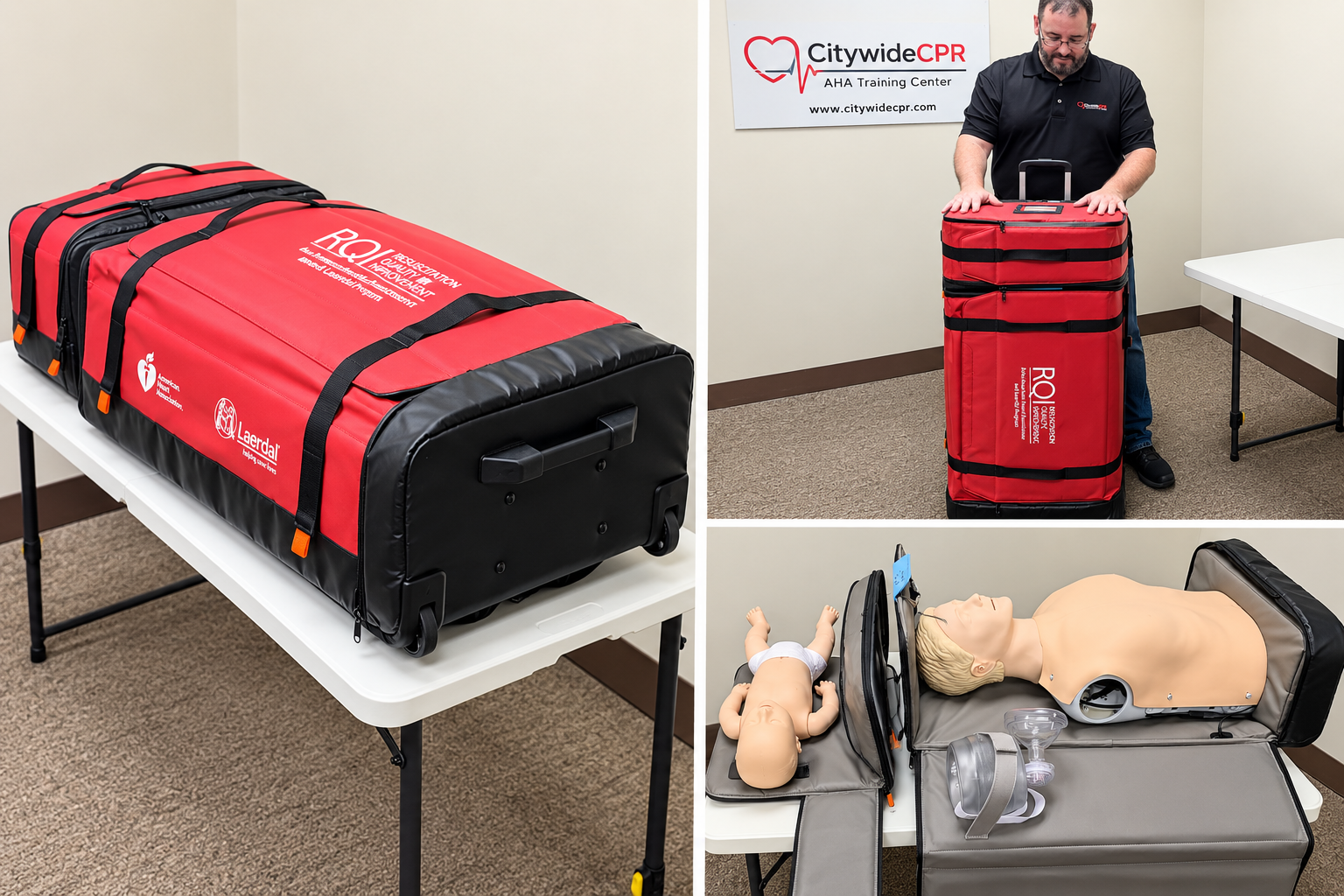
RQI-P GO is a portable CPR simulation and skills-verification system that can bring applicable hands-on CPR skills training directly to a healthcare facility.
Instead of requiring employees to travel to a separate training location for applicable skills verification, a portable system can allow the training process to take place at the organization’s facility.
Citywide CPR describes RQI-P GO as a portable solution that provides real-time audio and visual feedback during CPR skills performance, including feedback related to compression depth, rate, recoil, and ventilation. Citywide CPR
For a medical clinic, the potential scheduling benefit is straightforward: less employee travel and fewer scheduling conflicts associated with sending staff away from the workplace.
Citywide CPR’s healthcare staff program specifically describes RQI-P GO as an onsite option for organizations where taking employees off campus is impractical. Citywide CPR
RQI-P GO availability and the appropriate training arrangement depend on the organization’s needs and applicable course requirements.
How Should a Medical Clinic Coordinate BLS Training?
BLS planning should begin with an employee-by-employee review of certification status and expiration dates.
A clinic manager can create a simple tracker containing:
| Information | Why It Matters |
| Employee name | Identifies who needs training |
| Current certification | Shows what credential the employee currently holds |
| Expiration date | Helps prioritize upcoming renewals |
| Course needed | Identifies BLS, ACLS, PALS, or another applicable course |
| Online coursework status | Determines whether additional online learning is needed |
| Skills session status | Shows whether the hands-on component is complete |
| Completion documentation | Provides a record for the organization’s training files |
This approach can help prevent a situation where multiple employees discover at the same time that their certifications are about to expire.
How Should a Clinic Coordinate ACLS and PALS Training?
ACLS and PALS should be planned according to the specific certification requirements applicable to the employees and organization.
A clinic may have employees who need BLS while other employees may also require ACLS or PALS based on their roles and responsibilities.
Rather than assuming every employee needs all three certifications, managers should verify their organization’s requirements and then create a training schedule accordingly.
Citywide CPR provides AHA BLS, ACLS, and PALS certification and renewal options for healthcare professionals and organizations. Citywide CPR
BLS Training for Medical Clinic Staff
BLS provides the foundational certification pathway for applicable healthcare professionals and staff. Clinics should verify which employees need BLS based on their specific organizational and role requirements.
For employees preparing for BLS certification or renewal, Citywide CPR offers applicable Online + Skills and Skills Only pathways.
ACLS Training for Medical Clinic Staff
ACLS addresses advanced cardiovascular life support and may be required for certain healthcare roles depending on the organization and employee responsibilities.
When multiple staff members need ACLS, a clinic can coordinate training around employee schedules rather than assuming everyone must attend at the same time.
PALS Training for Medical Clinic Staff
PALS focuses on pediatric emergency care and may be relevant to employees whose responsibilities include pediatric patients.
As with BLS and ACLS, the organization should confirm which employees actually need PALS before scheduling training.
Should a Clinic Schedule Everyone for Training at Once?
Not necessarily. A single group session can be useful in some circumstances, but it is not the only way to coordinate staff certification.
A clinic may choose a group or onsite approach when:
- Multiple employees need the same training.
- The organization can temporarily allocate staff for training.
- Coordinating one training period is operationally practical.
Individual or smaller-group scheduling may be more appropriate when:
- Employees work different shifts.
- Patient coverage must remain available.
- Certification expiration dates are spread throughout the year.
- Employees have already completed different portions of their training.
- Removing the entire team simultaneously would create operational problems.
The right approach depends on the clinic’s staffing model and certification requirements.
How Can a Clinic Plan Renewals Before Certifications Expire?
Start tracking expiration dates well before they become urgent and stagger renewals when practical.
For example, if a clinic has employees whose certifications expire throughout the year, the manager can maintain a rolling list of upcoming expirations instead of waiting until several employees are approaching the deadline simultaneously.
A practical renewal workflow is:
- Review employee certification records.
- Identify certifications approaching expiration.
- Confirm the training pathway required for each employee.
- Determine whether individual, group, or onsite training is most practical.
- Schedule training around shifts and patient coverage.
- Update the organization’s records after successful completion.
This turns certification renewal into an ongoing administrative process rather than an emergency scheduling problem.
What If a Clinic Has About 20 Employees Who Need Training?
A mid-size clinic does not necessarily need to take all employees out of service simultaneously to coordinate certification.
For a team of approximately 20 employees, a manager could evaluate whether:
- Employees can be divided into smaller groups.
- Some employees can complete individual Self-Guided Skills Sessions.
- Different certifications can be scheduled on different dates.
- An onsite solution would reduce employee travel.
- Renewals can be distributed according to individual expiration dates.
For clinics with a larger or more complex staff-training need, Citywide CPR’s BLS, ACLS and PALS training for healthcare staff provides information about coordinating healthcare employee certification through both nearby CPR Verification Stations and portable onsite skills verification. Citywide CPR
The goal is to create a training schedule that works with the clinic rather than unnecessarily interrupting normal operations.
How Do I Set Up Staff Training With Citywide CPR?
Start by identifying your staff count, the certifications employees need, and your preferred training schedule.
When contacting Citywide CPR, it can be helpful to provide:
- Approximate number of employees
- BLS, ACLS, PALS, or other applicable courses needed
- Whether employees are completing initial certification or renewal
- Approximate expiration dates
- Facility location
- Whether onsite training is preferred
- Any scheduling limitations
This gives the training team the information needed to discuss the available options for your organization.
Request Staff Training for Your Medical Clinic
If your clinic needs to coordinate BLS, ACLS, or PALS certification for multiple employees, Citywide CPR can help you explore training options designed around your organization’s scheduling needs.
Whether your organization is considering onsite training, smaller-group scheduling, or individually scheduled Self-Guided Skills Sessions, the appropriate solution depends on your staff, course requirements, and operational needs.
Frequently Asked Questions About Medical Clinic Staff Training
How can a medical clinic schedule BLS training without disrupting patient care?
A clinic can stagger employee appointments, schedule smaller groups, or explore onsite training instead of taking the entire team away at once. Individual Self-Guided Skills Sessions may also provide flexibility when applicable.
Can a medical clinic coordinate BLS, ACLS and PALS training together?
Yes. A clinic can coordinate different certification needs as part of an overall staff-training plan. Employees should be assigned the courses that apply to their specific roles and organizational requirements.
Can employees complete their BLS, ACLS or PALS training at different times?
Yes, when the applicable training pathway allows individual scheduling. This can be useful for clinics where employees have different shifts or certification expiration dates.
What is RQI-P GO?
RQI-P GO is a portable CPR simulation and skills-verification system that can bring applicable CPR skills training directly to a healthcare facility. It provides real-time feedback during CPR skills performance and can reduce the need for employees to travel offsite. Citywide CPR
Can Citywide CPR provide onsite training for a medical clinic?
Citywide CPR offers onsite organizational training options that include BLS, ACLS, PALS, CPR/AED, and First Aid. Organizations can contact Citywide CPR to discuss their training needs and scheduling requirements. Citywide CPR
Does every employee need BLS, ACLS and PALS?
No. Certification requirements can vary by employee role, employer, facility, program, and other applicable requirements. Clinics should verify which certifications apply to each employee.
What if employees cannot all attend training on the same day?
A clinic can consider individual or smaller-group appointments, staggered scheduling, or onsite options. The appropriate approach depends on the organization’s staffing situation and applicable course requirements.
How far in advance should a clinic plan certification renewals?
There is no single scheduling timeline that applies to every organization. Clinics can benefit from tracking expiration dates in advance and planning training around staffing needs rather than waiting until multiple certifications are close to expiration.